Will Iron Ore and Scrap Availability Remain Key Challenges for India’s Steel Industry?
India’s steel industry is at a critical juncture because as it advances to its vision of achieving 300 million tonnes by 2030, the sector needs to maintain a balance growth with sustainability, resource security, and social responsibility. However, if we look at the growth it has been structurally strong, despite persistent challenges around raw materials, energy transition, and technology adoption which basically shapes the story of how successfully the vision has to be accomplished.
A structurally strong demand outlook
India has been able to sustain high steel demand in last decade (Read full transformation https://www.metalbook.com/blogs/indias-steel-industry-a-decade-long-structural-transformation/). Unlike earlier cycles driven by short-term infrastructure spurts, today’s growth is underpinned by deeper structural factors: rising per capita incomes, accelerated urbanisation, housing demand, manufacturing expansion, and large-scale public infrastructure investment.
Over the past decade, government capital expenditure has increased more, supporting roads, railways, ports, urban infrastructure, and energy projects. Combined with infrastructure pipeline and “Make in India” initiatives, steel demand growth is structural rather than cyclical. This reinforces the idea that growth and decarbonisation must advance together one cannot be postponed for the other.
Industry stalwarts widely agree that India is focusing on both growth and sustainability. With steel demand expected to remain strong for decades, embedding decarbonization into expansion plans from the outset is seen as essential to avoid future stranded assets, regulatory shocks, and loss of competitiveness in global markets.
Secondary steel: the backbone of Indian steelmaking
For decades, India’s steel ecosystem has been uniquely shaped by the secondary route, particularly induction furnaces (IFs) and DRI-based operations. Almost half of India’s crude steel production is dependent on secondary producers, the major regions such as Jalna, Durgapur, Raipur, and Mandi Gobindgarh are the hub of it.
Secondary steel was basically perceived as lower quality, but with time and sustained investment in operations has fundamentally changes this perception. Modern IF steel meets all stringent quality requirements across all major applications. Secondary steel also plays an important role in employment generation, MSMEs development, and regional industrialisation.
Secondary steel producers strongly emphasized that India’s heavy reliance on the secondary route should be viewed as a structural advantage rather than a weakness. Secondary producers offer flexibility, faster capacity addition, and lower capital intensity—qualities that are particularly valuable in a capital-constrained, fast-growing economy. Policy frameworks, they say, must be aligned to strengthen this sector.
Raw materials: iron ore and scrap under pressure
One of the most pressing risks facing the industry is the growing mismatch between steel capacity expansion and raw material availability.
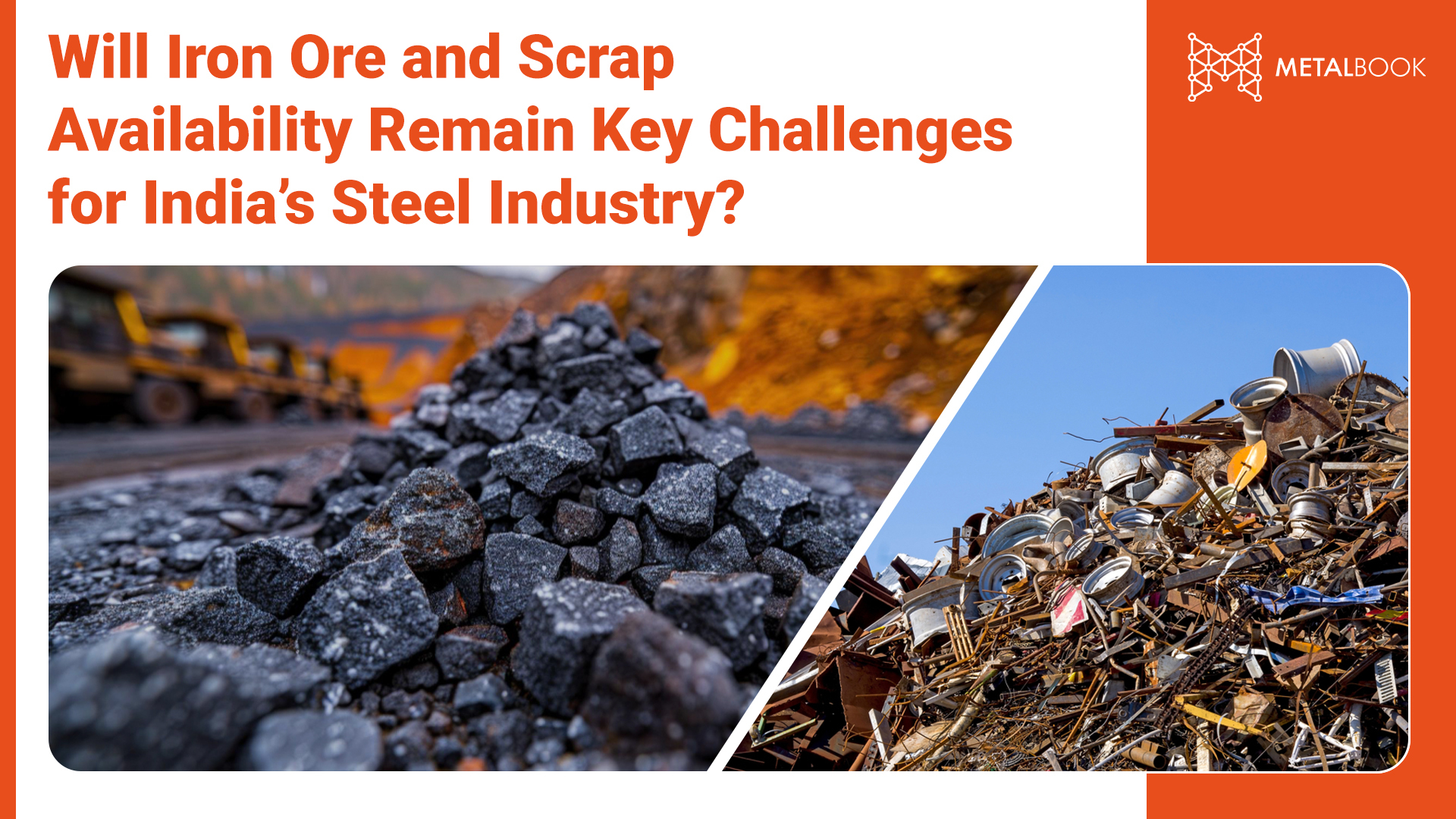
Iron ore production has grown steadily but at a slower pace than steelmaking. Over time, ore quality has declined, merchant mining availability has tightened, and auction-related premiums have increased costs, particularly for secondary producers that lack captive mines. Policy ambiguity around beneficiation, low-grade ore utilisation, and mine approvals has further amplified supply uncertainty.
Scrap availability poses an equally significant challenge. India remains structurally scrap-deficient and relies heavily on imports, exposing producers especially MSMEs to global price volatility and logistics disruptions. Low bulk density scrap inflates transport costs, eroding margins.
Several practical, near-term solutions exist: scrap shredding at source to increase bulk density, improved scrap segregation, greater use of rail logistics, and redesigned sponge iron transportation using specialised containers. These measures do not require breakthrough technology but can deliver immediate efficiency gains.
The scrap is not a marginal input but a resource, so it is very important to increase scrap intensity and availability has been expected to rise sharply with the help of vehicle scrappage system. But the major issue faced in scrap is the high tax, fragmented collection, and cash-based transactions at the first level of aggregation discourage formal flows. Without fiscal rationalisation and stronger enforcement, a large share of scrap risks remaining informal, limiting quality control, traceability, and scalability.
Decarbonisation
India’s steel sector is under increasing pressure to reduce emissions, yet it remains more carbon-intensive . Coal-based DRI continues to dominate, reflecting India’s resource realities and cost sensitivities.
While “green steel” and hydrogen-based pathways dominate long-term discussions, the more urgent question is how to reduce emissions today without undermining competitiveness. Incremental decarbonisation measures offer realistic progress:
- Small modular vertical-shaft DRI units that can run on syngas today and hydrogen in the future
- Waste heat recovery systems, low-pressure turbines, and off-gas utilisation
- Partial substitution of coal with natural gas where infrastructure permits
- Electrical gas heaters and selective electrification
- Use of biomass and biocarbon in rotary kilns to displace fossil carbon
Individually, these steps may not deliver net-zero outcomes, but collectively they can materially reduce emissions while preserving cost efficiency.
Energy and hydrogen
Decarbonization will ultimately depend on clean electricity and hydrogen. However, both present formidable challenges. Large-scale hydrogen-based DRI would require a dramatic increase in power generation—potentially many times current steel-sector consumption—along with grid upgrades, massive renewable capacity, and complementary sources such as nuclear energy.
Hydrogen production, transport, storage, and pricing remain unresolved at scale. Until these constraints ease, transitional solutions using syngas, natural gas, and biomass are not optional—they are essential.
India’s decarbonization pathway must be anchored in energy realism. Without reliable, affordable clean power and hydrogen at scale, premature mandates could damage competitiveness. Transitional fuels and hybrid systems are therefore seen not as delays, but as necessary bridges.
R&D: the weakest link and biggest opportunity
One recurring concern across the industry is underinvestment in research and development. India’s overall R&D spend remains well below that of advanced economies, and industry-led research in steelmaking is limited.
Breakthrough challenges—such as hydrogen-based DRI, beneficiation of low-grade ores, carbon capture, and biocarbon integration—are too complex and capital-intensive for individual firms to tackle alone. They demand collective action through industry platforms, public–private partnerships, and deeper collaboration with academic institutions such as the IITs.
Financing, liquidity, and market signals
Decarbonizing the steel industry necessitates hundreds of billions of dollars in time. Still, there is considerable uncertainty regarding how costs will be divided between producers, consumers and the state due to the significant cost premium associated with green steel.
Several financial mechanisms are helping alleviate liquidity issues, especially for MSMEs, including carbon markets, monitoring, reporting and verification (MRV) frameworks, trade-related instruments and digital financing platforms; however, the ability to access these sources without restriction in the long-term and therefore obtain large amounts of capital will depend critically on a stable and predictable system of incentives and demand signals.
Social license and community engagement
In addition to regulatory approval, social acceptance is now seen as a critical factor in the successful advancement of mining and industrial developments. The early involvement of local communities, generating employment, contributing to skills development and providing alternative livelihoods are all now seen as an integral part of sustainable growth—as opposed to as 'peripheral' or 'nice to haves.
The 'Social License' concept has evolved from Corporate Social Responsibility (CSR) into a key component of successful mine and industrial expansion— arguably making the case that companies now have more ethical responsibilities.
The road ahead
India’s steel demand will continue to rise, and decarbonization must enable—not constrain—this growth. Secondary steel and the induction furnace route are not anomalies but pillars of the industry. Raw material availability, quality, and logistics represent immediate risks requiring coordinated policy and industry action.
Most importantly, incremental and practical decarbonization measures must move forward now, even as hydrogen and green power ecosystems scale up over time. The transition will be taking time, but with right balance that is vision and the policy being taken forward in this direction will help the Indian steel industry to grow sustainably and competitively.