The Changing Landscape of Working Capital Financing in India’s Manufacturing Sector
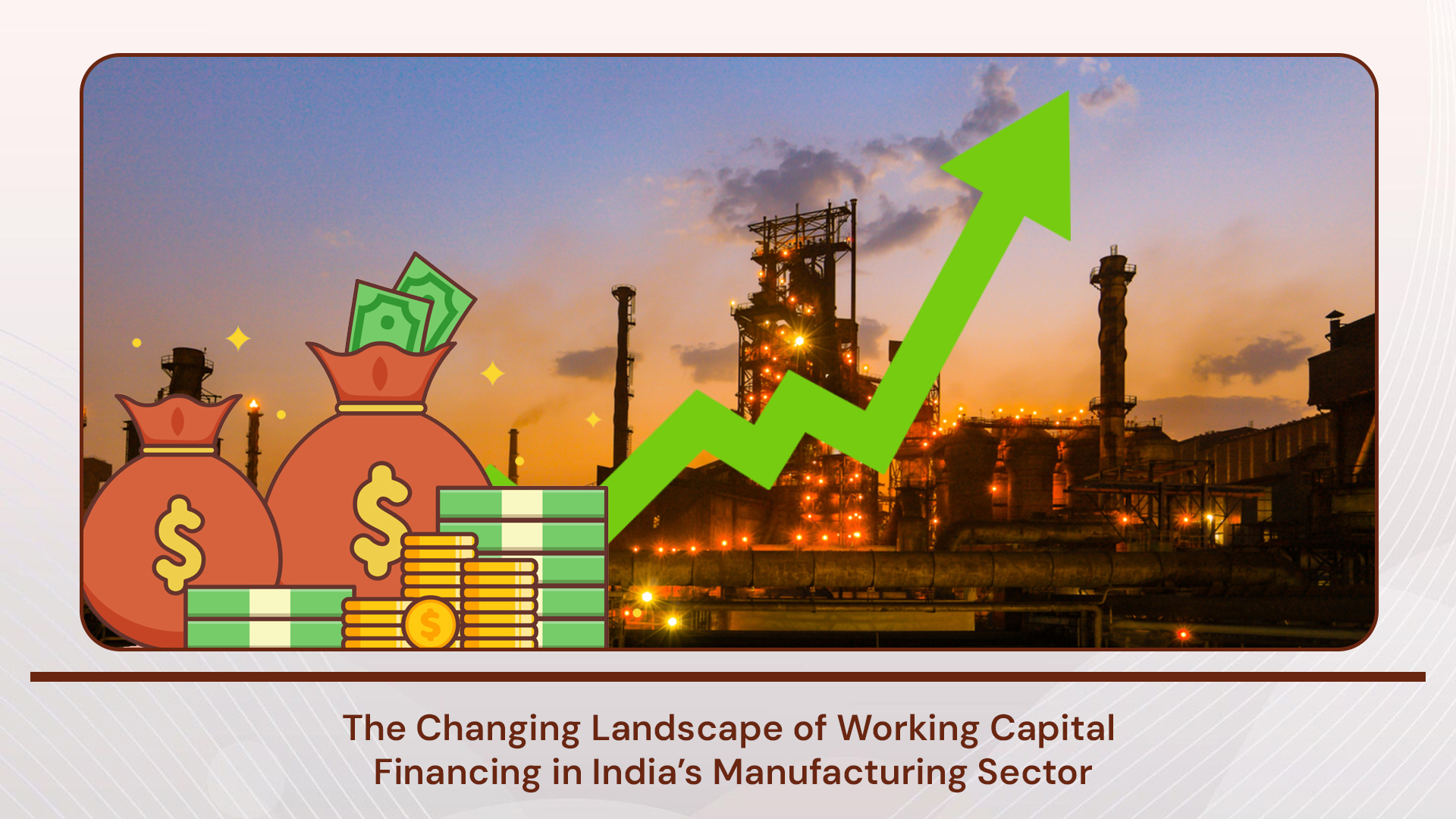
Cash is still king but how you get it is no longer the same
If your factory is operating at maximum capacity, but customer payments are coming in 60–120 days late, your growth will be stunted, irrespective of how efficient your shop floor is. The mechanics of working capital in Indian manufacturing have changed substantially over the last 3–5 years as invoice discounting and Trade Receivables Discounting Systems (TReDS) have appeared, credit rails driven by GST, quicker financing from NBFCs, and more competitively priced supply-chain finance (SCF) options are providing manufacturers with improved access to cash that is faster, cheaper, and more transparent. This is not a trend; it is driven by policy, new digital rails, and measurable adoption.
Why this matters for manufacturing-:
Manufacturing accounts for a large share of the India GDP and export mix; efficient working capital allows for plant scalability, timely raw material purchases, and export commitments.
For many MSMEs and mid-tier manufacturers, traditional bank credit and internal accruals are no longer sufficient; faster invoice financing and SCF can free up working capital from receivables and inventory.
The major forces changing working capital finance
1) TReDS and invoice discounting — receivables become cash quickly
TReDS (Trade Receivables Discounting System) platforms like Invoicemart, RXIL, and M1xchange enable MSME suppliers to upload their invoices; buyers agree to the invoices; and financiers then competitively bid to discount the invoices with the goal of providing suppliers with payment typically within 24–48 hours. TReDS has demonstrated sustained and real growth in both invoice volumes and MSME registrations, indicating that it is no longer a niche. This has de-risked suppliers by shortening their days-sales-outstanding (DSO) and introduced pricing competition among financiers.
2) GST-based, cash-flow lending
Government-sponsored programs and DFIs utilize GST filings, India Stack, and account aggregator data to provide on-tap invoice-based credit, often without collateral, for micro and small enterprises. These are created for small-value, high-velocity working capital requirements and have expanded the funnel of credit-eligible MSMEs.
3) NBFCs & fintechs: nimble underwriters + specialised products
NBFCs (non-banking financial companies) have emerged as crucial providers of supply chain finance, inventory funding, and invoice financing, often deploying alternative data, quicker underwriting, and more flexible collateral frameworks. KPMG, CRISIL, and industry studies illustrate that strong NBFCs are growing in the MSME and SCF sectors and address the lending needs that traditional banks neglected.
4) Digitisation & Open Credit Enablement Network (OCEN) / Account Aggregator (AA) frameworks
Digital public infrastructure (India Stack), OCEN (Open Credit Enablement Network), and account aggregators are creating quicker credit decisions, faster disbursals, and less paperwork while making cash-flow lending scalable and auditable. Already, SIDBI and public institutions are working on developing solutions on these rails.
5) Evolving product set: inventory financing, reverse factoring, dynamic discounting
It is not restricted to just invoice discounting; manufacturers are using increasing levels of inventory finance (loans against either their raw materials or finished goods), reverse factoring (buyer-led finance that offers suppliers better rates based on buyer credit), and dynamic discounting (buyers proactively offer to pay faster to agreed-upon discounts). Various papers from PwC and elsewhere emphasize supply chain finance as a toolbox, i.e., not a singular product.
The evidence: adoption and scale (key stats you can rely on)
Studies conducted by the Reserve Bank of India (RBI) and industry reports have indicated rapid growth in invoice financing volumes on digital platforms; these sources note some large year-on-year increases (i.e., levels of TReDS invoice financing values materially increased in recent years). This reflects real adoption by MSMEs and mid-sized manufacturers.
SIDBI and the Ministry of Finance have initiated GST Sahay as well as other types of digital lending pilots, which aim to scale invoice-based lending for micro enterprises. These pilots seem to have become part of the government strategy to drive credit inclusion.
Benefits manufacturers are getting:
Faster cash conversion: Invoices converted to cash within 24–48 hours rather than waiting 60–120 days.
Lower effective cost for good counterparties: Reverse factoring leverages buyer credit profile to lower financing cost for suppliers.
Collateral-light lending: GST-based and invoice financing often require limited physical collateral, reducing borrowing friction for MSMEs.
Better working capital planning: Digital platforms integrate with ERPs and give predictable cash flows for procurement and production planning.
Risks and practical limitations:
Buyer acceptance dependence: Invoice discounting via TReDS requires buyer acceptance, large buyers/PSUs are more likely to participate than smaller buyers.
Cost variability: Discounting rates vary with buyer credit, financier competition and market rates, not always cheaper than a bank overdraft for the top credit profiles.
Digital onboarding and data quality: Effective usage depends on GST data consistency, clean invoicing and ERP integration. Poor data increases rejection rates or pricing penalties.
What manufacturers should do this quarte
Map your receivables & DSO (30/60/90-day buckets) and identify 20% of invoices that, if financed, would free the most working capital.
Pilot TReDS with one platform (Invoicemart, RXIL or M1xchange) for a sample of buyers — measure time-to-cash and net cost after discounting fees.
Assess GST Sahay eligibility (for micro units) — SIDBI’s app can provide invoice-based offers quickly; it is ideal for purchase or sales invoice financing.
Talk to NBFCs for inventory finance — if raw material cycles are the pain point, inventory finance or supply-chain loans from NBFCs may be faster than bank limits.
Integrate accounting/ERP with the chosen platform — automation reduces rejection and manual work. PwC and industry reports stress integration as a success factor.
How buyers (large corporates) can help their supplier ecosystem
To stabilize the manufacturing supply chain and reduce supplier insolvency risk, buyers can consider reverse factoring, shortening acceptance cycles on TReDS, and committing to onboarding key suppliers to invoice-discounting platforms. This helps secure a robust supply base, and many large buyers are testing such programs already.
Top platforms & players to evaluate
Invoicemart (TReDS) — widely used; ERP integrations; positioned for MSMEs and corporates.
RXIL (TReDS) — publishes impact assessments and invoice volumes; good for PSU and corporate receivables.
M1xchange (TReDS) — a fintech-led platform with growing adoption among MSMEs.
SIDBI — government / DFI-backed app for GST-based invoice financing and small value loans.
NBFCs & fintech lenders — explore players with inventory financing and supply-chain products; check their underwriting speed, chargebacks and post-disbursement support.
Conclusion
The manufacturing sector of India is seeing a transformation of its working capital financing from opaque relationship-driven limits at banks to a more diverse digital ecosystem that includes TReDS and invoice discounting, a GST-based cash-flow lending ecosystem, NBFC product innovation, and buyer-led reverse factoring. For manufacturers, this results in faster cash, lower friction , and alternatives to traditional solutions; however, successful engagement requires attention to data hygiene, selective piloting, and integration into their existing digital infrastructure. Government programs and DFI programs have already developed rails (GST Sahay, OCEN, and AA) to scale up this momentum, and the next step is execution at the manufacturing facility level.

Frequently asked questions