India’s Steel Industry: A Decade-Long Structural Transformation
Introduction
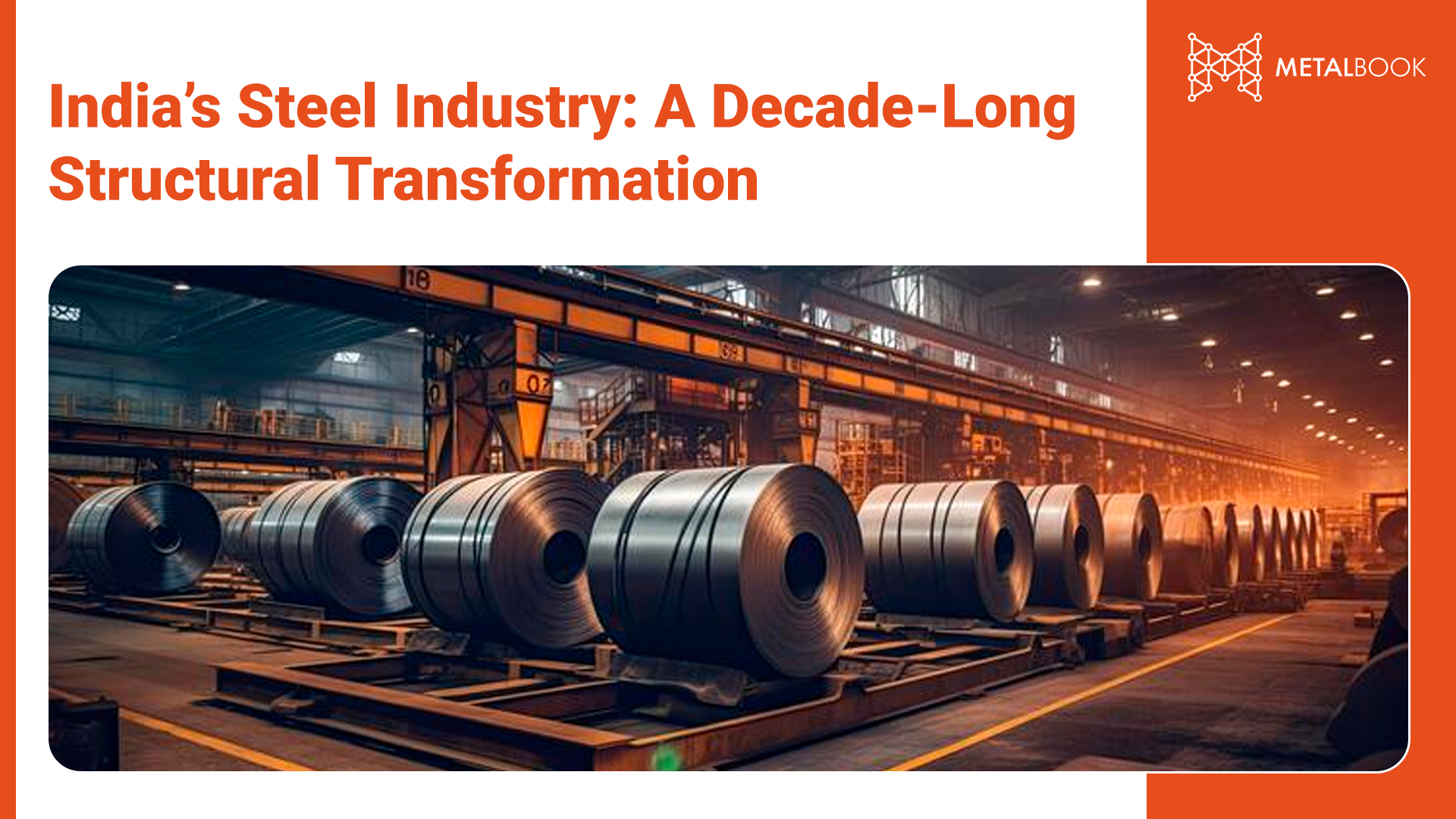
The Indian steel industry has experienced major structural transformations in the last decade. Over the period, the country has expanded its installed steelmaking capacity from approximately 109 million tonnes in 2015 to more than 205 million tonnes by 2025, rising further to about 210-212 million tonnes in FY26. On the other hand, production has increased, reaching nearly to 148 million tonnes in FY26, while domestic steel consumption expanded to around 140 million tonnes. This progress has been due to deliberate policy intervention, large investments in infrastructure, and coordinated corporate expansion.
Industry Context Prior to the Transformation
The Indian steel industry was not able to compete globally due to its structural limitations. While it had ample iron ore resources, there were many challenges facing the steel sector; for instance, operational capacities were widely spread out geographically, meaning that utilization rates were generally very low compared to other countries, and it relied heavily on imported coking coal. Specialty steel production in India was also minimal at this time; therefore, India depended entirely on importing high-value specialty steels (i.e. Coated Steels, Alloy Grades and Electrical Steels). The Chinese steel industry dominated the global marketplace due to its substantial over-capacity, resulting in a high prevalence of dumping, as well as a great deal of price instability in domestic markets across the globe. Financial stress among producers, compounded by weak demand and high leverage, further constrained investment and modernization.
Policy-Led Structural Reform
However, the industry saw a turning point when the government came up with the articulation of long-term policy frameworks designed to provide visibility, demand assurance, and technological direction. The National Steel Policy of 2017 played an important role by setting an ambitious target of 300 million tonnes of capacity and 255 million tonnes of production by 2030. The policy focused on raw material security, promoted scrap-based steelmaking, and encouraged both greenfield and brownfield expansion in mineral-rich regions.
Along with it, the Domestically Manufactured Iron and Steel Products policy was introduced to ensure preference for Indian steel in government procurement. Initially introduced “melt and pour” criterion, this policy ensured that steel used in public projects was produced domestically. Progressively, with revisions in 2020 and again in 2025, the policy evolved to include domestic value addition norms, stronger compliance requirements, and expanded coverage for all projects and particularly in infrastructure-heavy sectors such as railways, highways, and urban development.
The PLI Scheme and the Shift to Specialty Steel
PLI scheme, introduced in 2021, aimed to address India’s dependence on imports of high-grade steel by incentivizing domestic production across categories such as coated steel, alloy steel, and grain-oriented electrical steel.
The launch of PLI Scheme 1.1 in January 2025 further refined the incentive structure by lowering entry thresholds, allowing rise in capacity. These changes had a significant impact by FY26, as they encouraged companies not only to substitute imports but also to create exportable products in premium steel categories.
Corporate Expansion and Capacity Growth
Indian Steel industry made a lot of investments to achieve the target that was set and also become globally competitive. JSW Steel emerged as one of the most aggressive companies by increasing its capacity from around 18 million tonnes in 2015 to approximately 33 million tonnes by FY26. At the same time, JSW has invested in expanding its Vijayanagar and Dolvi facilities with support from the Government of India through the Production Linked Incentive (PLI) scheme for Alloy Steels and Coated Steels. This positions JSW at the lower end of the global steel cost curve. The major plus point is its coastal plant locations which has enabled efficient access to export markets, allowing the company to export between 13 and 14 million tonnes annually by FY26.
Tata Steel, conversely, followed a somewhat different route with an emphasis on providing quality products to customers, developing an integrated producing environment and a focus on exporting premium steel products. Tata Steel had approximately 20 million tonnes of production capacity in 2021; however, this number will increase to nearly 27 million tonnes in FY26, primarily due to the expansion of Tata Steel's Kalinganagar facility. In addition, Tata Steel's involvement in the Production Linked Incentive (PLI) program for Cold Rolled Grain Oriented (CRGO) and Advanced High Strength Steel (AHSS) products further solidifies its competitive position in the Electrical and Automotive Steel segments. Tata Steel's numerous Distribution Hubs throughout several countries allow Tata Steel to rapidly move high-value premium steel products to European and UK markets. In addition, AM/NS India has increased its annual production capacity of approximately 9 million tonnes to approximately 16 million tonnes by FY26, primarily focusing on Flat Steel Products and High Strength Steel. AM/NS India leverages its Technology Transfers and its location along the Hazira coast to create a very strong export orientation. While SAIL is less focused on the export of Steel Products, SAIL has made significant investments to modernize its production capabilities, enabling stable levels of Annual Capacity (about 20 million tonnes) and becoming a reliable supplier to support growing Domestic Infrastructure.
Domestic Demand and Infrastructure Push
Without strong domestic demand, the expansion would not be possible, the large-scale government initiatives such as PM Gati Shakti, the National Infrastructure Pipeline, smart cities, and renewable energy programs has been the significant pillars for generating consistent steel consumption across various sectors. Urbanization and housing demand further reinforced consumption, resulting in domestic steel usage rising from about 100 million tonnes in 2019–20 to approximately 140 million tonnes by FY26. This infrastructure-led demand provided volume stability, while specialty steel demand from automotive, defense, and energy sectors improved product mix and margins.
Geopolitical Influences and Risk Mitigation
Various geopolitical events played an important role during the decade. The Russia–Ukraine conflict was one of the major issues as it not only disrupted global energy and coking coal markets, leading to sharp price volatility that affected production costs in India. At the same time, persistent Chinese overcapacity increased the risk of dumping in regional markets. India mitigated these risks through a combination of import monitoring systems, anti-dumping duties, and diversification of raw material sourcing. Initiatives such as the CoalSETU platform improved transparency and logistics in coking coal supply, while trade defense measures helped stabilize domestic pricing.
Export Emergence and Global Positioning
By FY26, the impact of policy reform, capacity expansion, and product upgrading had fundamentally altered India’s export profile. Steel exports have shifted away from low-value commodity grades toward specialty and value-added products. The leading producers have approximately exported between 13 and 15 million tonnes annually, and generated export revenues in the range of $10 to $15 billion. India’s share in global specialty steel trade has risen from roughly 2 percent earlier in the decade to about 5 percent by FY26, reflecting improved quality, scale, and reliability.
Sustainability and the Green Transition
The key focus never shifted from environmental sustainability and it emerged as a strategic priority toward the latter part of the decade. The government’s Green Steel and National Green Hydrogen missions encouraged steelmakers to explore low-carbon production routes, including hydrogen-based direct reduced iron, increased scrap usage, and energy efficiency measures.
Conclusion
The Indian steel sector is likely to achieve its ambitious target overcoming all challenges with the help of coordinated policy frameworks, targeted incentives, and large-scale investment. While challenges related to raw material security, global competition, and environmental sustainability is likely to be overcome through the foundations laid during this decade position India to play a central role in global steel markets in the years ahead.