India’s Steel Exports Surge 36% in 10MFY26 as imports fall sharply
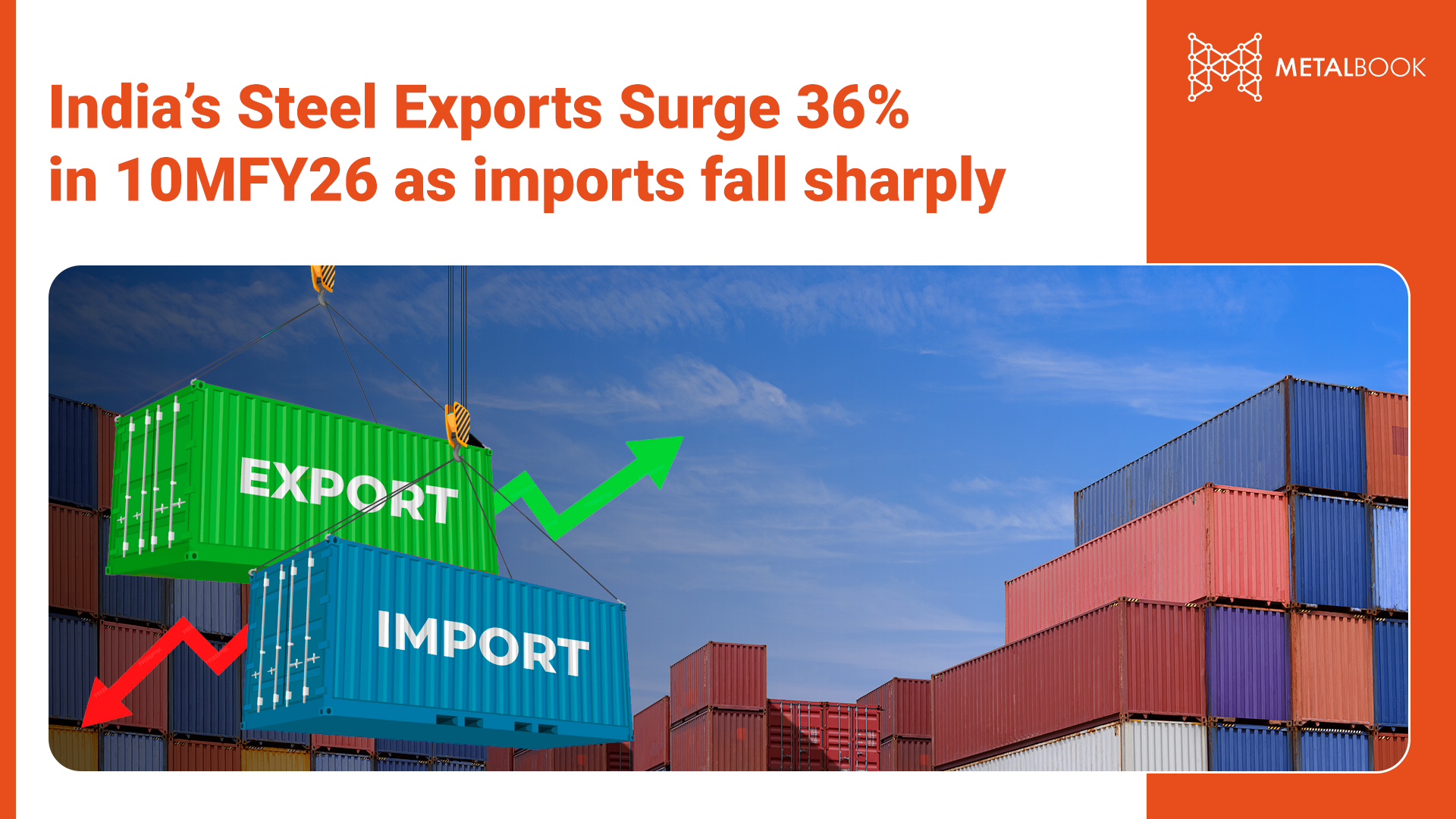
India’s steel sector has increased 36% in the first ten months of the fiscal year ending March 31, 2026, reaching a total of 7.65 million tonnes, bolstered primarily by high demand in the EU, Turkey, the UK, and South-East Asia. Meanwhile, steel imports fell sharply because of the imposition of safeguard duties, higher domestic production levels, and increased landed costs, which consequently reduced India's trade deficit greatly compared to previous years.

Analysts expect that Indian steel exporters will enjoy continued strong export growth; however, there is widespread belief that India will continue to be a net importer of steel through FY2026 and will see a significantly reduced trade deficit vs historical averages.
Exports vs Imports — Key Facts

1. Strong Global Demand
- Shipments to the EU were up (i.e. year-on-year) 26-45% as a result of increased purchases of imports by buyers due to CBAM going live in January 2026.
- Turkey and UK purchased large volumes of semi-finished products including billets. In April to July these products reached 4x the volume from the previous year.
- Vietnam, Oman, Qatar, and Taiwan had significant increases in volume of Hot Rolled Coils, pipes, and tubes.
2. Domestic Production & Policy Support
- Crude steel production in FY26 (10MFY26) is about ~140 mt up by 11% YoY
- PLI schemes and higher capacity utilization boosted efficiency.
- Safeguard duties (12% on flat steel) reduced imports, freeing domestic supply for exports.
3. Competitive Pricing & Logistics
- Indian exporters are able to use cost advantages and a stable rupee to offer attractive prices to international customers.
- Example: Hot Rolled Coils (HRC) in 2025 (Dec) are offered at $570/ton CFR Antwerp versus EUR 630/ton in the European domestic market.
India’s Steel Import Trends
Steel imports have fallen consistently across FY26 due to safeguard duties, higher domestic production, and costlier imports.

Key Observations:
- Imports fell sharply due to 12% safeguard duties on flat products.
- China and Japan shipments dropped drastically (~45–65% in Q1), while South Korea remained the leading supplier.
- Semi-finished imports were volatile but finished steel dominates trade balance (~4.65 mnt in 9M FY26).
Regional Highlights

FY26 Outlook — Net Exporter Status
- Full-year exports projected at 6–6.5 mnt; imports ~9.6 mnt.
- Net deficit ~0.6 mnt, much smaller than 3.64 mnt in FY25.
- EU CBAM and seasonal Q4 domestic demand will influence export patterns.
- Alternative export destinations: Southeast Asia, Middle East, Africa.
Overall, India’s steel sector has narrowed its trade gap while maintaining strong global competitiveness, despite likely remaining a net importer for FY26.

Frequently asked questions