India’s Steel Capacity: The roadmap from 200 MT to 300 MT
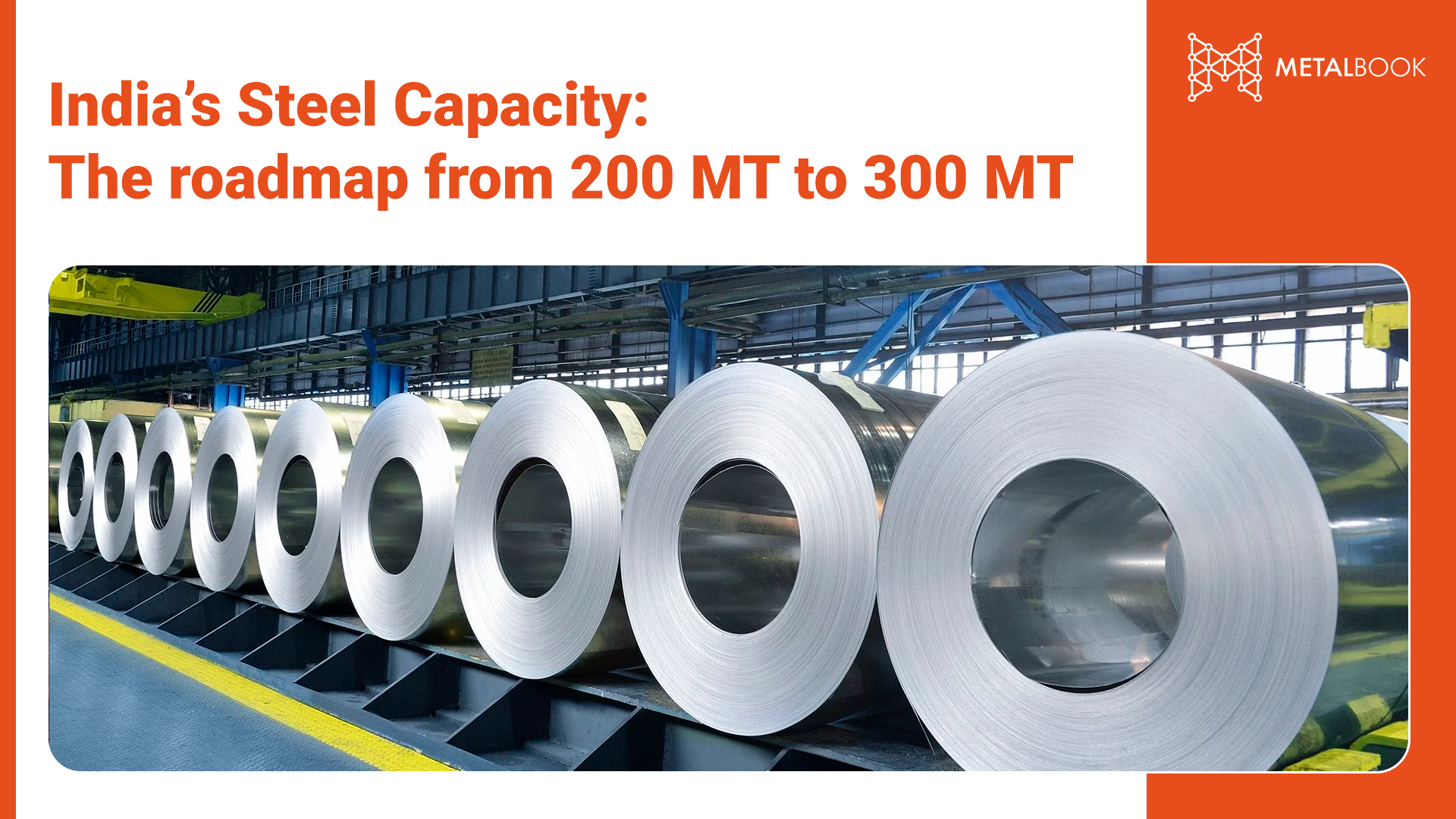

India’s steel industry has increased by approximately 10 per cent to reach 205 million tonnes in FY 25, strongly positioning the country as the world’s second-largest steel producer. This milestone reflects the efforts in the last two decades of sustained investment, policy interventions and demand growth driven from major sectors like infrastructure, housing, and industrialisation. With the current phenomenal achievement, the industry is poised to achieve 300 MT of capacity by 2030 and is also projecting to increase the capacity if all the announced projects are completed.
The expansion roadmap is anchored in a massive pipeline of 90–95 MT of planned capacity additions, spread across brownfield expansions and large greenfield integrated steel plants. These investments are being anticipated by long-term demand expectations linked to government capital expenditure, urban redevelopment, railway modernisation, defence manufacturing, and the broader push to localise industrial supply chains.
India’s steel capacity utilisation remains in the range of 72–75 per cent, with crude steel production trailing installed capacity by a significant margin. If new capacity is added without a commensurate rise in consumption or exports, utilisation levels might fall below 80 per cent, a threshold that historically signals margin pressure in capital-intensive industries like steel. Lower utilisation increases fixed-cost absorption challenges, intensifies price competition, and disproportionately impacts smaller or higher-cost producers.
India’s current expansion phase exhibits the earlier jump from roughly 100 MT to 165 MT of capacity during the previous decade. While that phase helped establish scale, it also coincided with periods of price volatility and financial stress across the sector. Globally, China’s experience between 2010 and 2016 offers a more cautionary parallel, where aggressive capacity creation led to chronic oversupply, depressed prices, and eventually state-led consolidation. Unlike China, India’s steel industry is predominantly private-sector driven, limiting the scope for coordinated capacity rationalisation and making strategic discipline by individual producers essential.
This expansion cycle is heavily concentrated in Eastern India, especially in the states of Odisha and Jharkhand, during the continuance of these risk factors. The availability of raw materials, transportation/logistics efficiencies and government(s) promoting investment/stimulating development are creating a 'heartland' of steel in this region in India with a much stronger future potential than any of the other three regions of India (Western, Northern and Southern).
Odisha alone accounts for nearly half of India’s iron ore reserves, providing steelmakers with a decisive cost advantage through reduced mine-to-mill transportation. In addition, the location of the eastern coast ports of Paradip and Dhamra further improves the potential to export steel to both Eastern and Western countries for those mills that are able to integrate their domestic and export market strategies with good logistical capabilities.
The large-scale capital investments associated with establishing the broader eastern region of India (i.e., Tata Steel's Kalinganagar Expansions) as a hub for manufacturing automotive-grade flat steel and JSPL's Angul Complex are also evolving into the largest integrated producer of long and flat products. Additionally, AMNS India has been expanding operations in these states, and the proposed joint venture between JSW-POSCO to develop an automotive-grade flat steel mill in Odisha validates the strategic importance of this region for producing additional steel in the future. In addition, these ongoing expansions are either forming or creating "cluster" effects, such as shared equipment, skilled labour, downstream and midstream processing, and lower costs for production.
The rise of Eastern India as a steel hub mirrors global examples where industrial clustering has strengthened competitiveness, such as Hebei in China or Pohang in South Korea. However, this introduces new challenges related to environmental clearances, water availability, land acquisition, and infrastructure execution. Delays or constraints in these areas could affect commissioning timelines and alter the projected capacity trajectory.
Strategically, the growth of India's steel industry from 200 million tonnes (MT) to 300 MT and beyond is an enormous opportunity, but also a test. The proposed growth aligns well with the goals of India's long-term development and offers the opportunity for the development of globally competitive clusters of steel producers. However, with the growth in the number of producers, the risk of overcapacity exists. As the number of producers increases, the emphasis will be basically on producing value-added products, readiness to export, and operational efficiency. Ultimately, the ability to absorb, utilise, and distinguish capacity growth from the competition will dictate the success of capacity expansion in the increasingly competitive global steel marketplace.