Indian Steel Mills Prefer Alternative Routes for Green Steel Over Hydrogen
Introduction
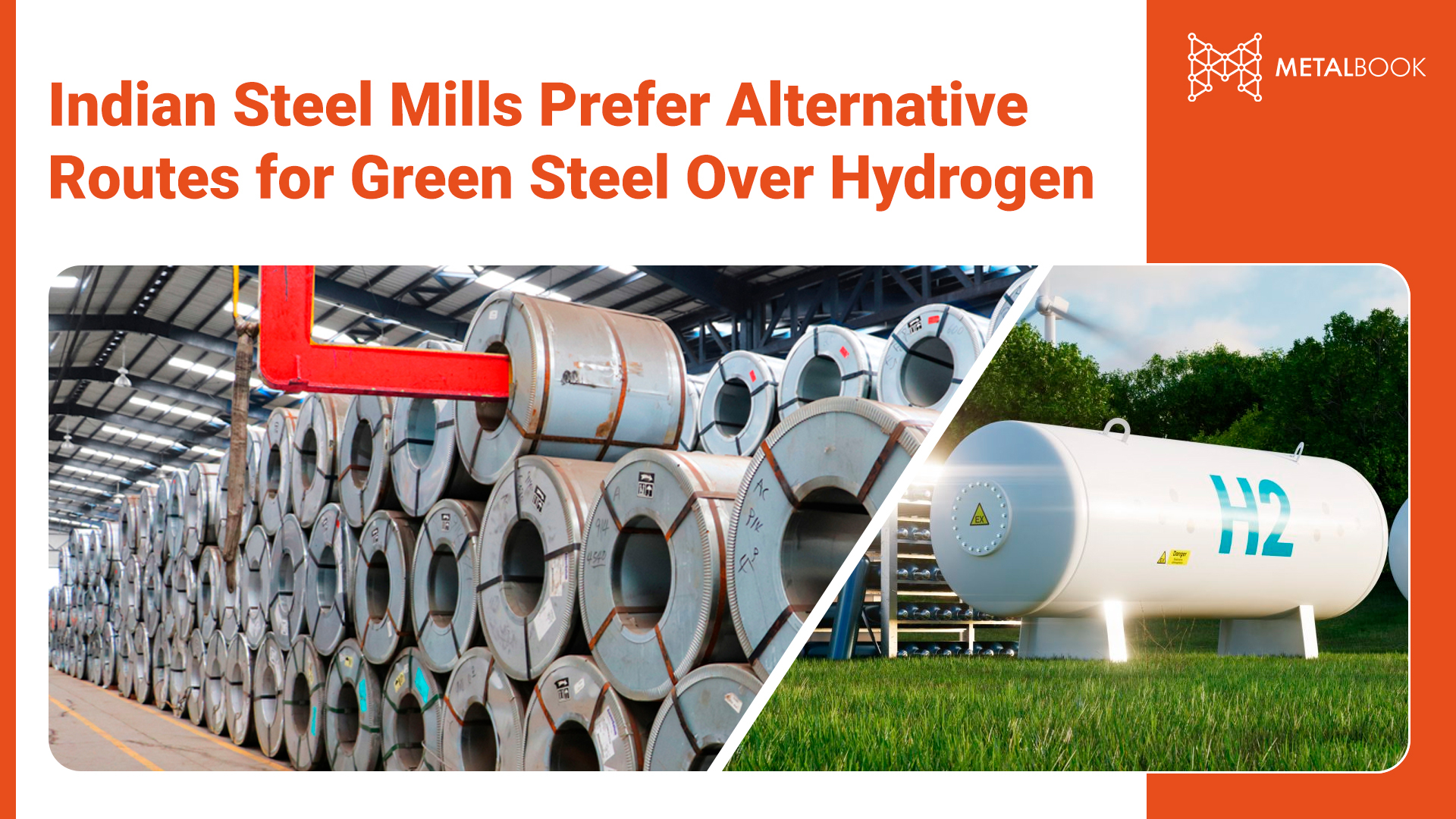
As the world works towards net-zero steelmaking , Indian steel producers are mapping a respectful and varied pathway. While green hydrogen is widely considered to be the ultimate decarbonisation technology, the immediate priorities of the steel industry are lower-carbon alternatives - scrap-based electric arc furnaces (EAFs), carbon capture and storage (CCUS), biomass gasification, and integrating renewable energy.
Some countries are already deploying full hydrogen-based direct reduced iron (H-DRI) technologies, including HYBRIT (Sweden) and SALCOS (Germany). In India, with steel demand still growing at 6-7% annually, hydrogen infrastructure is underdeveloped and high cost, companies are focused on lower-carbon pathways that are gradual and economically viable and also fit within India's developmental and industrial context.
Global Context: Hydrogen Leads, But Economics Lag
The steel industry generates around 7-9% of global CO₂ emissions: approximately 2 tonnes of CO₂ is released per tonne of crude steel by traditional BF-BOF (blast furnace + basic oxygen furnace) routes. Key actions globally include:
- HYBRIT (Sweden): World's first hydrogen-DRI project by SSAB, LKAB, and Vattenfall — professing fossil-free steel by 2030.
- ArcelorMittal (EU): Building 2+ Mt hydrogen-DRI plants in Germany and Spain, including public co-funding.
- POSCO (Korea) and Nippon Steel (Japan): Testing hydrogen-enrichment in blast furnaces and CCS as transitional abatement measures.
Yet, hydrogen remains both expensive ($3.5-4.5/kg) and energy-intensive. Analysts do not expect global hydrogen-based steel to be at price parity until 2035-2040, when green hydrogen reaches $2/kg or less, and renewable electricity becomes universally competitive with all other sources.
Indian Context: The Pragmatic Path to Green Steel
Why Hydrogen Alone Won’t Work Yet
The steel sector in India is responsible for the direct emissions of 12% of national emissions. In general, while decarbonising steel production via hydrogen-based DRI–EAF routes (Direct Reduced Iron-Electric Arc Furnace) is a great opportunity to eliminate emissions in an important sector, the sector faces significant challenges:
- Hydrogen price: Currently at $3.5–4.5/kg of hydrogen, which is nearly double what one would need for steelmaking to be potentially competitive with conventional steelmaking .
- Capital intensity: Transition to full hydrogen represents about USD 300 billion by 2070.
- Infrastructure gaps: Manufacturing in the ecosystem of electrolysers, pipeline, and hydrogen storage is all very limited at this time.
- Feedstock constraints: India's lower-grade iron ore makes DRI-based processes, which require greater than 67% Fe, much more difficult.
Most Indian producers, therefore, appear to be taking a "phased decarbonisation" approach- implementing near-term solutions (EAF, CCUS, biomass, renewables) while preparing for hydrogen in the next decade.
Alternate Routes Being Prioritised in India
Route / Technology | Emission Reduction (%) | Readiness in India (2025) | Key Example |
Scrap-based EAFs | 60–70% | Commercial | Tata Steel, JSW, AM/NS India expanding scrap use |
CCUS (Carbon Capture) | 30–35% | Pilot–Demo | Tata Steel Jamshedpur, JSPL feasibility studies |
Hydrogen Blending (Hybrid) | 20–30% | Pilot | JSW Steel Vijayanagar pilot (25 MW electrolyser) |
Biomass Substitution | 10–15% | Operational | JSPL & AM/NS India using biochar and pellets |
Renewable Energy Integration | 10–20% | Scaling | JSW, SAIL, and Tata setting up captive solar & wind plants |
Company Case Studies: India’s Green Steel Transition
Company | India Capacity (approx.) | Primary Alternate Routes Being Prioritised | Hydrogen Activity (Status) |
JSW Steel | ~32–34 MTPA (domestic crude capacity; expansion ongoing) | Renewables (2.5 GW captive), scrap/EAF expansion, energy upgrades, pilot green sites (Salav, Jagatsinghpur). | Vijayanagar pilot operational (~3.8 ktpa, first 1,000t DRI Q4 2025) |
Tata Steel | ~21.6 MTPA (India); group total ~35 MTPA | Renewables rollout, EAF/scrap projects, circularity; Kalinganagar at 40% scrap charge | Piloting pathways; near-term EAF/renewables focus |
SAIL (State-run) | ~19–20 MTPA | Renewable procurement (500 MW solar/wind PPAs), efficiency, scrap upgrades, CCUS assessment. | Hydrogen part of long-term roadmap; current focus on renewables and CCUS. |
JSPL (Jindal Steel & Power) | ~9 MTPA currently; Angul expansion to 24–25 MTPA by 2030 | Captive renewables, fuel substitution, modernisation via Jindal Renewables | MoUs for ~4,500 tpa green hydrogen capacity captive to Angul; early-phase development. |
Saarloha (Kalyani Group) | ~0.25 MTPA (Pune) | 100% renewable power + high scrap EAF (~70%+ scrap ratio). Produces low-carbon specialty steels via non-H₂ EAF. | Hydrogen not primary route; focused on EAF and renewables. |
Quantitative Metrics Assisting the Transition
- Cost of green hydrogen (2025): $3.5–4.5/kg → predicted to dip to $2/kg by 2032–2035.
- Steel CO₂ intensity in India: ~2.5 tons CO₂/ton steel (above the global avg of 1.9).
- Potential emissions reduction: Hybrid methods can reduce between 20 to 35% of emissions ahead of 2030.
- Green steel demand:
- FY30 – 4.49 million tons,
- FY40 – ~73.44 million tons (industry & automotive demand).
- Government programme – ₹5,000 crore in support for secondary producers under the Green Steel Mission.
- Capital needed – ~USD 300 billion until 2070 to transition completely.
- India’s capacity target – 300 MTPA crude steel by 2030 means multi-route decarbonisation is critical.
Policy and Institutional Enablers
- National Green Hydrogen Mission (2023) – ₹19,744 crore to scale green hydrogen production.
- Steel Scrap Recycling Policy (2020) – Solidified scrap supply chains to enable EAF scale-up.
- Perform, Achieve & Trade (PAT) Scheme – Provides incentives for energy efficiency throughout integrated steel plants.
- CBAM (Carbon Border Adjustment Mechanism) – EU carbon tariffs forcing exporters to reduce CO₂ intensity.
- Green Steel Mission (Proposed 2025) – Focused on new PLI-style incentives for the adoption of renewables and CCUS.
Global vs India: Contrasting Decarbonisation Pathways
Region | Primary Route Adopted | Cost Competitiveness (2025) | Primary Barrier |
Europe (Sweden, Germany, Spain) | Hydrogen-DRI + EAF | High-cost; supported by subsidies | Hydrogen cost and electricity price |
Japan & Korea | Hydrogen-enriched BF + CCUS | Moderate | Hydrogen logistics & scale |
China | EAF expansion + efficiency | High efficiency | Scrap availability |
India | Hybrid: EAF, CCUS, biomass, renewables | Cost-effective | Hydrogen infrastructure & ore grade |
Although the West is making an investment in hydrogen for the public benefit, India is taking China’s side in the philosophy of first scaling circular and efficient solutions, then adding hydrogen as it emerges.
Conclusion
India’s approach to the decarbonisation of steel is one that is multi-speed and multi-technology, based on what is most economically sensible and industrially feasible.
Hydrogen will be the long-term decarbonisation method, but in the next 10–15 years, steelmakers will decarbonise much more quickly by increasing scrap recycling, the piloting of CCUS, integration of renewables, and energy efficiency.
By 2030, it is projected that India’s steel sector emission reductions will be at 20–25% from the 2020 baseline level, based on all the above entries, not radical hydrogen change, but continuous, practical improvement.
India’s model may well define a “transitional blueprint” for emerging economies, balancing growth, affordability, and sustainability in the march toward green steel.

Frequently asked questions