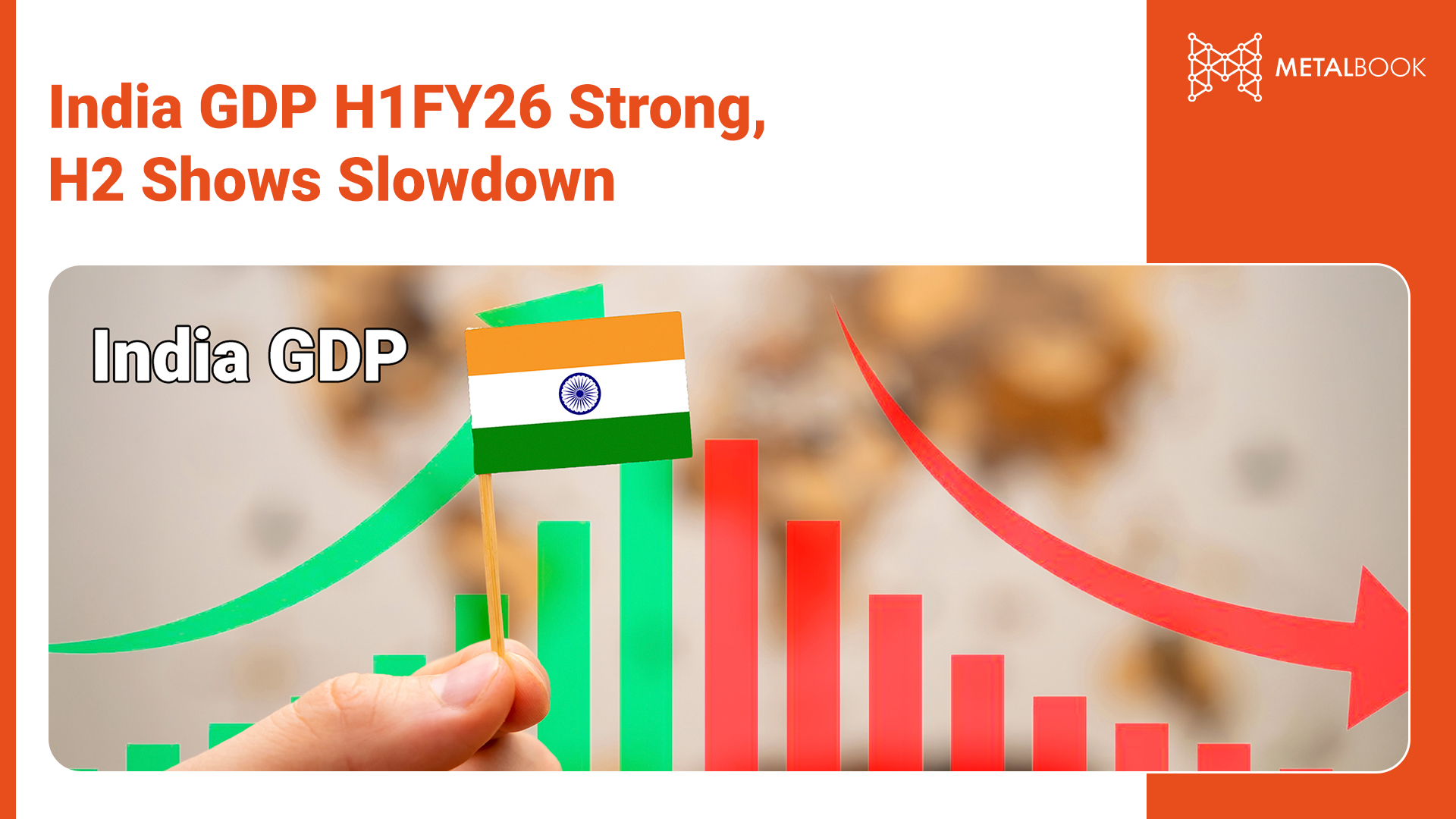
India GDP H1FY26 Strong, H2 Shows Slowdown
Key Takeaways
- H1FY26 strong growth with real GDP rising 8% and Q2 at 8.2% driven by consumption, services and manufacturing.
- Industrial slowdown in H2FY26, with IIP growth at only 0.4% in October and declines in capital goods and consumer durables.
- Exports under pressure as engineering exports fell 16.7% YoY due to US and ASEAN tariffs and weak global demand.
- Policy support measures with higher government capex and RBI likely maintaining a dovish stance to sustain growth.
Introduction
The first half of FY 2025‑26 witnessed strong growth for India’s economy. In Q2, real Gross Domestic Product (GDP) expanded by 8.2%, the fastest in 18 months and well above market expectations. When combined with 7.8% growth in Q1, the first-half average stands at 8.0%, prompting several forecasters to raise full‑year projections for FY26 toward 7.0–7.5%.
Nominal GDP growth during this period was more modest, which reflects subdued price pressures, a dynamic that is understood to have partly inflated the real growth via a weak deflator.
The composition of growth in H1 offers encouraging signals. Private consumption, which accounts for over half of GDP, remained robust, aided by a favourable price environment, likely stimulus from tax cuts, and seasonal consumer demand. Manufacturing output rose strongly, while the services and construction sectors also showed healthy expansion. Agriculture and allied sectors observed modest but stable performance, rounding off a broadly based growth story.
Early H2FY26 -Cracks Begin to Show
As the economy entered H2FY26, several high-frequency indicators began to show signs of softening, suggesting that H1’s strong performance may not automatically carry over into a stellar full year.
The slowing industrial activity took centre stage as the IIP (Index of Industrial Production) reported a growth rate of only 0.4% for October 2025 (Y/Y), down significantly from a revised figure of 4.6% for September. The deceleration was widespread across all sectors of manufacturing, as manufacturing activity as a whole only grew by 1.8%. Both mining and electrical production saw declines (-1.8% and -6.9%, respectively), as did the consumer durable and non-durable goods sectors, indicating weak demand and possible overhang of inventory on hand.
On the trade front, the data from October 2025 regarding exports of engineering products, which represent a significant portion of India's tradable manufacturing base, was a cause for concern because the exports dropped a massive 16.7% on a Y/Y basis. The decline is broad-based and affected exports to several major markets (US, ASEAN, EU, and UAE), and analysts cited both the punitive tariffs imposed by the US and the decline in global demand as contributing factors.
The negative effects of this slowdown are evident in the external account. The current account deficit (CAD) for the first quarter of FY26 widened to 1.3% of GDP from 0.2% for the previous quarter, reflecting both reduced foreign exchange inflows and increased imports (particularly precious metals), as well as declining competitiveness of exports.
These developments, a slowing industrial sector and shrinking exports suggest that a manufacturing‑led revival is under strain. This raises concerns about underlying investment momentum and the sustainability of growth in the coming quarters.
Divergence Between H1 strength and H2 stress
Economic growth for FY 2026 appears strong, with GDP growth, supported by consumption, Services, Manufacturing and government spending. Despite that fact, there are signs of emerging structural weaknesses underneath the overall surface.
- Lack of industrial growth and decreases in export-type goods indicate that the manufacturing growth "cycle" may be slowing, along with a decrease in output of consumer goods. The evidence of slow growth or caution of domestic demand is an indication of potential future weak domestic demand.
- There are external factors placing pressure on export activity, such as the slowdown in global demand and the imposition of punitive trade tariffs. The trade deficit continues to widen, and a larger current account deficit increases the risk related to the external factors.
- While official government GDP estimates for the full year have been revised upward, it is critical to evaluate how "good" those estimates will translate into actual production going forward. The "low" GDP deflator and relative "holding" of “neutral/flat” nominal output will mean that both consumer goods and investment are equal in fragility.
- While this represents a dilemma for Policy Makers, the option of being aggressive with monetary loosening likely stimulates demand; equally possible, but not guaranteed, is it will create substantially greater inflationary pressures as/if they start creating currency fluctuation, devaluation and global currency volatility on the domestic economy; Fiscal restraints will keep Policy makers from supporting future investment and consumption.
Major Risks and Areas of Concern in Future Quarters
In the second half of Fiscal Year 2026 (H2FY26), India encounters numerous significant risks, which have the potential to affect whether the Indian Economy can maintain its current pace, or whether it will shift to be on an upward to slower growth trajectory, including:
- Decreased global demand and trade restrictions: With worldwide tariffs currently increasing, along with fewer purchases made by people globally, many businesses' exports (particularly engineering and manufactured products) will face increased barriers and may result in decreased levels of exports.
- Decreased industrial production: If the Index of Industrial Production (IIP) continues to decline past October, with the majority of negative impacts seen primarily in the Capital Goods sector and the Durable Goods Sector, it can negatively impact both manufacturing and employment while also hindering the investment level in India and further impacting the level of consumer consumption in India.
- Increased current account deficit and pressure on foreign exchange reserves: The current account deficit is expected to widen, while imports will likely continue to remain elevated (including precious metals), thus resulting in muted capital inflows that will put additional strain and pressure on the country's foreign exchange reserves and/or currency.
- Conflict between Fiscal and Monetary Policy: The Government, to support its economy, will likely have to find a balance between providing the necessary public Capex to help support the economy and managing the fiscal deficit. The Central Bank will be faced with a similar challenge to define its monetary policy moving ahead. While cutting rates could assist in increasing demand, it may also create increased inflationary pressure and/or risks of a decrease in the value of the currency.
- Quality of the economic growth rate: The nominal GDP growth of India is considered to be limited, and the Consumer Price Index Deflator is very weak, so sustaining consumer consumption and business investment will be critical to India maintaining its GDP Growth Rate in the future without continued reliance on inflationary adjustments.
Conclusion
The first half of FY26 confirms India’s economy has a fundamentally resilient basis to continue through the year. The combination of high levels of consumer demand, strong growth in the Service sector, solid growth in Manufacturing and continued government investment in building infrastructure, hotels/resorts, etc, provides a strong basis for the Indian economy for the upcoming year. The beginning of the second half of FY26 is projecting upward movement, but early indicators indicate a tougher road ahead - declines in Industrial Output, decreased Export volume, widening Trade Deficits, Increased Current Account Deficits and so on. To achieve continued sustainable growth out of FY26 and into FY27, India must continue to consolidate efforts and provide support in the areas of improving External Competitiveness and creating an environment that provides incentives for Investment and Manufacturing to expand beyond Front-Loaded Production to sustain India as a Competitively Priced/Global Production site. Support for the External Account, bringing into play a well-balanced, sustained Fiscal and Monetary Policy, is also critical for sustaining Growth in FY26 and beyond. If the policy-makers achieve their goals, India will likely exceed the 7% Growth target in FY26 as well, and the quality and sustainability will be more critical than the number. As FY26 progresses, keep watch for the Monthly Industrial Productivity Reports, Export and Trade figures for November/December, and any associated Deceleration or stabilization indicators. These could prove to be key indicators for success or warning signs for FY27.

Frequently asked questions