Impact of 12% Safeguard Duty on Flat Steel Imports
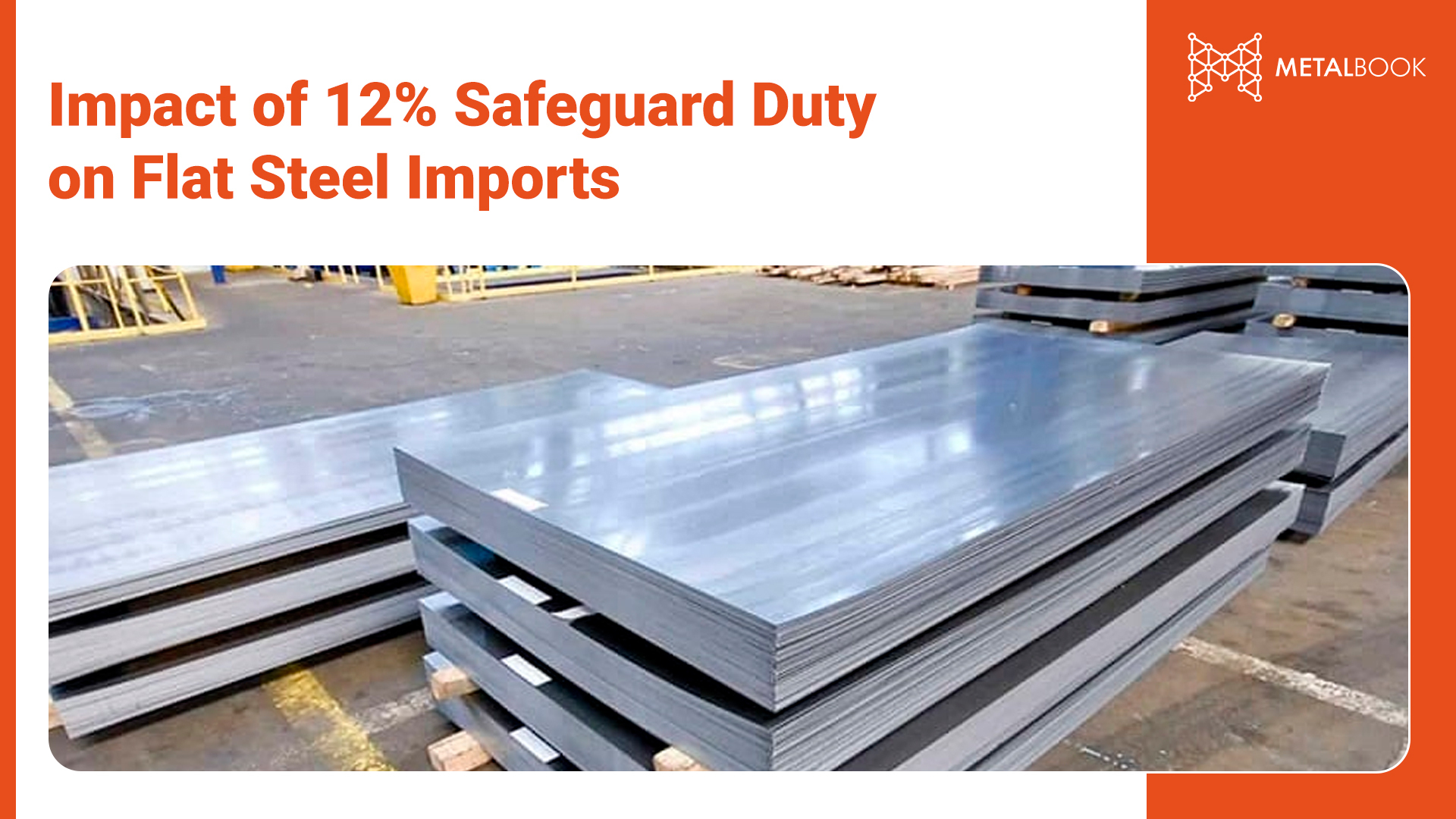
Abstract
The flat steel industry in India, over the last five years, has undergone fundamental changes. This is due to strong local demand, an oversupply of flat steel from the global market and increasing low-cost imported flat steel. According to the Indian Ministry of Steel, total finished steel imported into India in FY24-25 is estimated to be approximately 9.5 million to 9.6 million tonnes — a mid-teens growth over last year — with hot, cold and coated flat steel products making up a large portion of the increased volume. In April 2025, the Government of India imposed a 12% safeguard duty on certain flat steel imports to counter the surge of imports.
This case study provides a review of the historical data, initial results of the safeguard duty through December 2025 and scenarios for FY 2025-26, including production, capacity utilization, pricing and margins. The analysis showed that the safeguard duty has provided short-term support to restore some measure of domestic competitiveness; however, it also leaves significant structural vulnerabilities for the future.
Background and Context
By FY2023–24, India transitioned from being a net exporter to a net importer of finished steel, with imports rising faster than exports and domestic use continuing to rise Finished steel import volumes in fiscal year 2023-24 were between 8 and 8.5 million tonnes, and India had been a net importer for two consecutive years, reflecting an ongoing shift in market conditions. Cheap flat‑steel imports from China, South Korea and Japan began to significantly undercut domestic prices, pressuring realizations and margins of large integrated producers such as JSW Steel, Tata Steel and SAIL, and straining downstream re‑rollers and service centres.
In FY2024–25, import volumes for finished steel reached an estimated level of approximately 9.5–9.6 million tonnes with a mid-teens percentage growth rate compared to the previous fiscal year. Import volumes of flat steel products, including hot-rolled (HRC), cold-rolled (CRC), and coated products, continue to dominate total finished steel imports due in large part to their broad acceptance and the attractiveness of the price at which they are being offered to steel fabricators in the country. Indian domestic manufacturers continued to add capacity, but production utilization rates at many of the nation's integrated steel plants remain in the 75-80 per cent range, while many of the country's downstream manufacturers are faced with reduced margins and increased pressure from financial distress resulting from decreased demand at the end-user level.
Policy Intervention: 12% Safeguard Duty
The Government of India had imposed a provisional 12% safeguard duty on imports of flat steel on April 21, 2025, due to the rapid increase in imports. The duty was imposed after the concerns were raised by the Directorate General of Trade Remedies (DGTR). It covered selected flat‑steel products, including hot‑rolled coils/sheets/plates, cold‑rolled coils/sheets, metallic‑coated and colour‑coated products for a period of 200 days.
DGTR’s investigation also outlined a potential framework for a longer‑term safeguard arrangement, including a tapering schedule over three years (for example, 12% in the first year, followed by marginally lower rates in subsequent years), subject to further review and government approval. The primary objectives were to prevent the sudden import surge, align import‑parity prices with domestic mill offers, stabilize capacity utilization, and provide sufficient time for domestic producers to adjust to global oversupply and low international prices.
Historical Trends: FY2021–FY2025
Between FY2020–21 and FY2024–25, India’s crude‑steel output had risen steadily, supported by capacity additions and strong downstream demand from infrastructure, construction, automotive and capital goods. Finished‑steel production has seen an upward trajectory from the mid‑90‑million‑tonne range in FY2020–21 to above 130 million tonnes by FY2024–25, while apparent consumption followed a similar trajectory.
Despite these gains, imports continued to play an important role in meeting demand for high‑grade and specialized flat products. Flat‑steel imports have also increased materially over this period, roughly doubling from the low‑single‑digit‑million‑tonne range in FY2021–22 to around 7–7.5 million tonnes by FY2024–25. By late FY2024–25, large integrated mills were typically operating in the mid‑70s to low‑80s percentage utilization range, while several smaller downstream mills were operating below optimal utilization and facing margin and liquidity stress.
Market Response up to December 2025 (FY2025–26 to Date)
Provisional data for April–December 2025 indicate a noticeable moderation in rolled/flat steel imports, with estimated year-on-year declines of 15–20%. It had been observed that CRC and coated products recorded the sharpest reductions due to their direct coverage under the safeguard duty.
The decline in import competitiveness allowed domestic flat steel prices to recover, narrowing the spread between domestic and landed import prices, particularly for HRC and CRC. Integrated producers reported stronger order books, and industry estimates suggest that utilization rates at major flat steel mills rose from the mid-70%–low-80% range toward the high-80% range during 2025. Furthermore, the inventory levels across mills and service centres also felt the heat as they declined, and EBITDA per tonne improved relative to FY2023–24, though profitability remained sensitive to global price movements and raw material volatility.
Structural Considerations and Risks
The safeguard duty addressed the immediate surge in low-priced imports but did not succeed in eliminating the broader structural risks. The diversion of imports into semi-finished categories will remain a concern, as they are not uniformly covered under the safeguard measures. The persistent global oversupply, particularly from East Asian producers, continues to exert downward pressure on international prices, which has been raising the risk of renewed import inflows if safeguard measures expire or are relaxed.
Domestic producers also remain vulnerable to fluctuations in coking coal and other key inputs. Downstream MSMEs continue to experience financial stress due to thin margins, limited pricing flexibility and working capital challenges. Long-term competitiveness will depend on accelerated investments in process efficiency, digitalization, equipment upgrades and the development of advanced, high-strength, corrosion-resistant and coated products that still constitute a significant portion of imports.
FY2025–26 and Calendar 2025 Outlook
Based on trends observed up to December 2025, finished steel imports during FY2025–26 are expected to moderate slightly. Annual volumes are likely to stabilize around 8.5–9.0 million tonnes, reflecting a lower monthly run rate compared with FY2024–25. Flat steel imports are projected to remain in the 6–7 million tonne range, lower than the previous fiscal year but still substantial, particularly for specialized grades.
India's iron and steel imports reached record highs in 2024 because of both volume and price. Early data for 2025 has signalled that, despite the new safeguard duty implemented during 2024, expected volumes and values will be lower than what was seen during the 2024 calendar year. However, full-year results will depend on trade flows in Q4/2025 and whether the safeguard measures remain in place or are changed.
Domestic hot rolled (HRC) and cold rolled (CRC) flat products pricing is expected to trade within a relatively narrow trading range for the near term; the combination of strong domestic demand, continued weakness in international prices, and the overall stabilizing impact of trade measures will all have impacts on pricing. Large integrated steel manufacturers should continue to have higher EBITDA margins per tonne compared to the FY2023–24 level, while smaller enterprises in the value-added goods and services sector may see moderate increases in overall input costs, but they should also be more predictable than in past years.

Related Content

India’s Construction Industry vs Global Practices: A Cost–Technology–Supply Chain
Will Iron Ore and Scrap Availability Remain Key Challenges for India’s Steel Industry?
India’s Steel Industry: A Decade-Long Structural Transformation