Decoding Cash Flow Challenges in the Infrastructure and Fabrication Ecosystem
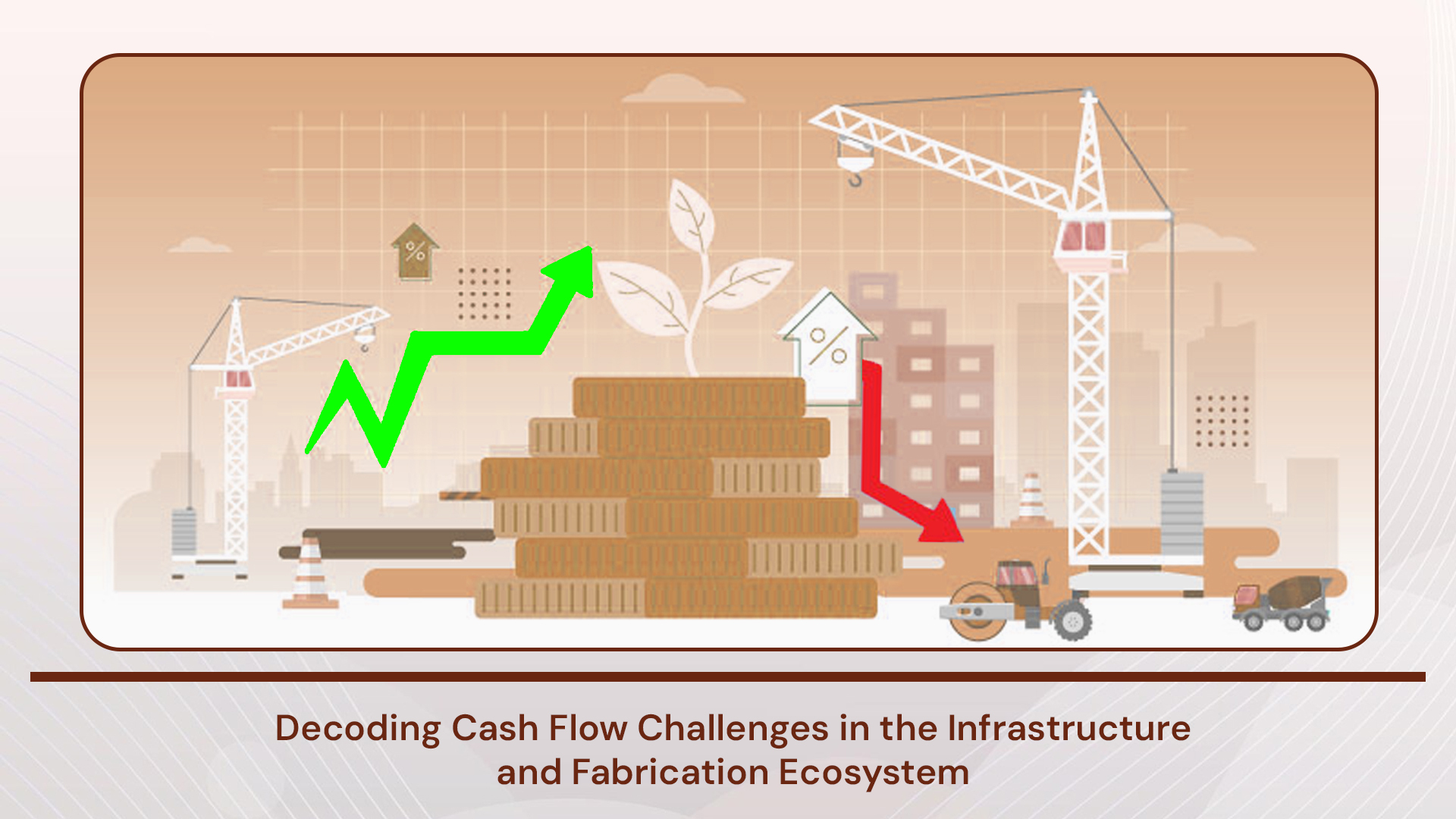
This is the cruel reality of cash flow problems in infrastructure and fabrication businesses. It is not enough just to do good work; you have to survive the waiting time between delivery and payment.
What Makes Cash Flow Different in Infrastructure Projects
Long project cycles and delayed payment realization
Unlike other businesses where you sell something today and get paid tomorrow, infrastructure and fabrication are not like that. These are long-cycle operations, so months can easily pass between the start of the work and the actual money in your account.
Multiple stakeholders and approval layers
When it comes to fabricating components for bridges, buildings, or industrial plants, you have to deal with a number of stakeholders. Among them are the main contractor, the subcontractor, perhaps a consultant, and a government body or a large corporation at the top that is funding everything.
Every layer adds time to your payment.
Costs that cannot wait
The worst part? Your costs will not wait. Raw materials have to be paid for in advance. Workers expect to be paid every month. Equipment rentals, electricity, transport—all these bills are due, and your payment may not even arrive yet.
According to the latest statistics, the majority of suppliers in construction and fabrication face the issue of customers delaying payments, and that’s why invoices are taking almost two months to be cleared. So, companies have to manage their functioning either with borrowed funds or depleted reserves for the entire two months.
The Payment Delay Epidemic Nobody Talks About
Late payments as a systemic issue
Most of the people not connected with the industry might be surprised to hear that payment delays are not just accidental problems. They are an intrinsic part of the system.
In India, more than 60% of payments to small manufacturers and fabricators are said to take place after the agreed credit periods. For businesses with profit margins of only 5 to 10%, waiting an extra month or two for their payment is not just inconvenient but can also prove to be a death knell.
Why Payments Get Stuck
Buyer dominance and power imbalance
The causes differ, but they are predictable and the same every time.
Major buyers and contractors usually hold all the cards. They dominate the supply chains and can stretch payment terms to anything they like. A minor fabrication unit supplying to a mega infrastructure project does not have any negotiating power when the buyer's invoice payment period is suddenly increased from 45 to 90 days.
Government contracts and administrative delays
Government contracts are a further complication. Public sector projects have several approvals, releases of budgets, and red tape that can only be measured in years.
Retainage and margin erosion
Besides the retainage, there is always the question of the retainage. It is an absolute standard to withhold 5-10% of the entire contract amount until construction is done. In case your profit margin is just above 5%, then the holdback essentially wipes out your profit while you wait for months till the project is officially closed.
How Working Capital Becomes a Survival Issue
Understanding working capital in infrastructure businesses
Working capital is a technical term denoting the cash necessary to maintain the business's daily operations. It is a non-risky strategy and a normal practice in economy and capital-intensive businesses, but for the companies in the infrastructure and construction industries, working capital management is a matter of subsistence.
The Vicious Cycle
Cash flow delays leading to lost business
When payments are not received on time, you won't be able to get the basic materials needed for your next order. You won't be able to take up new contracts and hence will start to lose future business opportunities. You may have to use costly short-term loans to cover the gap, which would further reduce the already very small profit margins.
Supplier relationship strain
To cope with the situation, some companies try to delay payments to their suppliers. This gives them temporary comfort, but on the other hand, it ruins the goodwill built up during the years. Suppliers may demand payment in advance or may not give you priority over other customers when there is a shortage of materials.
A case of one fabricator was exemplified when the delay in payments from a major infrastructure project compelled him to say no to three new orders just because he could not buy the raw materials necessary to start the work.
That's a lost sale due to cash flow timing and not because you lack the capability to produce.
Hidden Costs That Keep Adding Up
Loss of early payment discounts
Payment delays not only block the flow of your cash but also multiply your costs.
If you fail to pay your suppliers on time, you cannot avail of the early payment discount that is generally offered of 2-5%, which would have otherwise improved your margins.
Penalties, credit score damage, and higher borrowing costs
Late payments may also attract penalty interest from the vendors. Your credit score will suffer, and consequently, future loans will be harder and more expensive.
Opportunity cost of blocked capital
Moreover, there is an opportunity cost as well. The money, which is stuck in the form of unpaid invoices, could have been put to better use by upgrading the machines, training the employees, or taking up another profitable project. Rather, it remains idle in the account of someone else's receivables.
Administrative burden of chasing payments
The overhead due to administration is also important. Someone needs to monitor the payment delays, make calls, send reminders, and keep track of the invoice that has been pending with the respective party. This is productive time wasted on getting money that has already been earned.
Traditional Solutions Didn't Work
Limitations of bank loans
"Get a bank loan" seems to be an easy solution, but it misses the main idea completely.
Secured loans, the usual way of getting money from a bank, are not available for most small fabricators. The machines they use may be on lease. They might be operating in a rented factory. Basically, the security items that banks want are not there.
Long-term debt for short-term problems
However, when loans are granted, they are added as a long-term debt to your balance sheet. You are resolving a cash flow timing issue by taking a long-term debt commitment.
Credit line exhaustion risks
In addition, the approval gets delayed due to it being a lengthy process that takes weeks or even months, unacceptably slow when you have to pay your suppliers next week.
Lines of credit are useful, but they come with problems of their own. Small businesses often exhaust their credit limits during slow payment periods. This leaves them with no financial floor for emergencies or unexpected opportunities.
Impact of Cash Flow Limitations on Business Operations
Project Delays and Quality Compromises
Fabricators unable to get funds immediately may delay buying top-quality materials and settle for what is available. The quality of the end product will be affected, and this will lead to rejections or rework, which will incur additional costs.
Not being able to mobilize resources on time causes project delays. The reputation loss comes along with the delays, as contractors may be reluctant to give future projects to you.
Workforce Stability
It is very difficult to find skilled fabricators and welders and even more difficult to retain them. The best workers start looking for jobs elsewhere when cash flow problems lead to delayed salaries or reduced hours. The loss of experienced personnel impacts productivity and quality for months after.
Growth Opportunities Lost
India is experiencing a massive infrastructure development boom. The work is unending; new highways, metro projects, and industrial corridors are a few. But to take advantage of these opportunities, one needs working capital to ramp up production, invest in quality certificates, or keep larger stocks.
The companies that are constantly battling cash flow crises are unable to think about growing. They will be only considering “how to survive till the end of the month?”
The Domino Effect Through Supply Chains
Cascading financial stress across vendors
Financial troubles are not limited to a single entity. They affect the entire supply chain, cascading down and around the chain. The delay in payments to a manufacturer, for instance, is really a delay to the raw material suppliers. Then the latter ones will have their own hardships with the payment to their vendors.
Supply chain disruption risks
The multiplication of the effect causes financial stress to several businesses interconnected in dozens.
This is very much a problem in sectors with the suppliers involved heavily in the production processes. Finding a new vendor is not only a time-consuming task but may also lead to a loss of quality if they are not able to fine-tune their processes to meet your requirements.
Large infrastructural projects are dependent on the timely delivery of thousands of small and medium companies' skilled components. The disruptions of cash flow at even a few of those suppliers will mean that whole project timelines will be affected.
What the Data Tells Us
Working capital fragility across the sector
Recent surveys conducted show that the situation in the industry is quite alarming. 43% of contractors and fabricators cannot cope with unexpected expenses or project delays due to a lack of working capital.
Payment cycle mismatch
Even worse: 41% of firms having revenues of Rs 15 million and above only apply for extra working capital when they are already in trouble.
The disparity between the expected payment date (about 30 days) and the actual amount of time the manufacturer has to wait to get paid (average 56 days) leads to a huge cash flow gap that small companies need to manage somehow.
Managing the Cash Flow Challenge
Build Payment Terms Into Contracts
The contract must state the clear periods for payments with the penalties for delays. Instead of waiting for the entire project delivery, milestone-based payments can be included.
Track Everything Meticulously
By knowing precisely where your money is, that is, both what is owed to you and what you owe, you can predict cash crunches before they become crises.
Diversify Customer Base
Relying on one or two large clients exposes you to their payment habits.
Consider Alternative Financing
Invoice discounting and supply chain finance allow you to free up cash that is tied up in unpaid invoices without resorting to conventional loans.
Negotiate Smartly With Suppliers
Supplier relationships established and developed over the years can come in handy as a source of flexibility when cash flow problems arise.
The Bigger Picture
Industry awareness and gradual reform
The problems related to cash flow in the infrastructure and fabrication sectors are not going to disappear by themselves.
More and more people are becoming aware of the issue. Financial solutions that are specially tailored to these problems are appearing in the market. Moreover, government measures such as Section 43B(h) of the Income Tax Act are providing incentives for immediate payments to smaller suppliers.
Though the changes are gradual, they are nonetheless taking place.
Key Takeaway
Infrastructure and fabrication cash flow problems are a direct result of late payments, retaining money, and power imbalance. These problems are not simply financial drawbacks; they may lead to business extinction, restrict expansion, and create downstream effects across the supply chain.
Proper contract management, alternative financing, and systematic cash flow tracking are the three survival tools in this ecosystem.