Why CCUS Is Critical for India’s Steel Industry
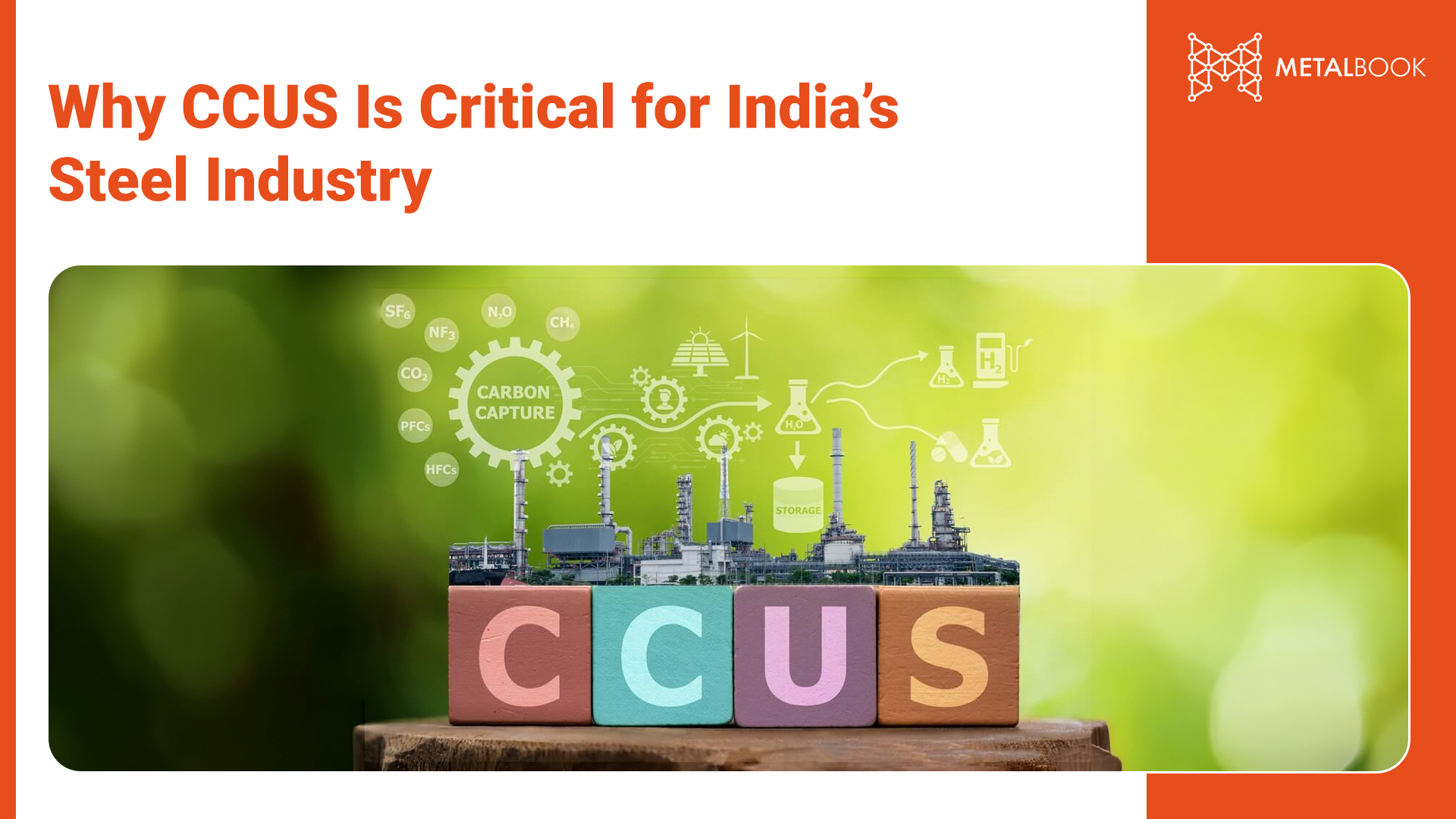
The Indian steel sector is one of the major carbon emitters, which cannot be eliminated quickly or cheaply through electrification or renewables alone. Being the world’s second-largest steel producer and still expanding capacity, CCUS is no longer an optional technology; it is a transition necessity.
Recently, in the current Union Budget 2026–27, with a ₹20,000 crore allocation for Carbon Capture, Utilisation, and Storage (CCUS) over five years, directly addresses one of the steel sector’s hardest realities.
India’s Steel Emissions: A Structural Challenge
Primary steelmaking via the blast furnace basic oxygen furnace (BF–BOF) route emits 2.4–2.6 tonnes of CO₂ per tonne of crude steel. Carbon is not just a fuel in this process it is chemically essential for iron ore reduction.
India’s steel capacity is dominated by BF–BOF assets that are:
- Relatively new
- Designed for 25–30 years of operating life
- Central to domestic infrastructure and manufacturing growth
Early retirement of these assets is neither economically viable nor aligned with India’s development priorities. This makes retrofit-based decarbonisation the only realistic path in the near to medium term.
Why DRI and Hydrogen Alone Won’t Be Enough
Hydrogen-based Direct Reduced Iron (DRI) is often positioned as the future of green steel. But there is major constraint in the large-scale deployment:
- Insufficient hydrogen infrastructure
- The cost of hydrogen is relatively high
- Long gestation periods for new DRI capacity
- Scrap availability and quality challenges for EAF routes
While DRI and scrap-based steelmaking will expand over time, they cannot displace existing blast furnace capacity fast enough to meet emissions targets or trade pressures this decade.
This is where CCUS plays a bridging role, reducing emissions from existing blast furnaces, coke ovens, sinter plants, and captive power units while alternative technologies mature.
CCUS and the Budget Signal
The ₹20,000 crore CCUS allocation marks the first time India has provided explicit, long-term financial backing for industrial carbon capture.
Key implications for steelmakers:
- Full government funding for select semi-commercial CCUS projects, reducing first-mover risk
- Support for pilot and scale-up projects linked to heavy industry clusters
- Policy recognition that steel decarbonisation requires multiple parallel pathways
Globally, over 1,800 million tonnes of CO₂ capture capacity has already been announced. India’s move aligns it with international decarbonisation trends—while tailoring solutions to domestic asset realities.
However, with there has been mixed signals from industry experts, as some are taking this a positive initiative and supporting industry in being competitive. But few are not so convinced as they believe that on paper it is good but what would be the final output which matters the most, as this requires a lot of process planning before implementation. Thus, is the country having all respective resources which would make the policy initiative more impactful.
CBAM: The Real Commercial Trigger
For Indian steel producers, decarbonisation is no longer driven only by climate commitments it is driven by trade economics.
The EU Carbon Border Adjustment Mechanism (CBAM) links carbon intensity directly to import costs. As reporting tightens and levies increase:
- High-emission steel will face rising landed costs
- Export margins will compress, particularly in flat and value-added products
- Carbon intensity becomes a price variable, not just a disclosure metric
CCUS allows steelmakers to lower reported emissions intensity from existing plants, helping manage CBAM exposure while longer-term transitions are underway. For exporters, this can mean the difference between remaining competitive and losing market share.
Energy Security and Steel Economics
India imports ~88% of its oil and ~50% of its gas, making energy security inseparable from industrial policy. Steel production remains closely linked to coal, particularly for blast furnaces.
CCUS especially when integrated with coal-based steelmaking and industrial clusters offers a pathway for a sustain domestic steel output and along with it will help to reduce emissions without increasing import dependence. It will also support a phased transition to hydrogen rather than a disruptive leap. This makes CCUS a strategic enabler, not a contradiction, of India’s long-term energy transition.
What Steelmakers Need Next
Budgetary support alone is not sufficient in order to scale CCUS in steel, India will need:
- Clear rules on CO₂ transport, storage, and long-term liability
- Shared infrastructure such as CO₂ hubs and pipelines to reduce costs
- Carbon pricing mechanisms that protect trade-exposed steel producers
- Public procurement and green steel mandates to create early demand
Early adopters will gain advantages in export resilience, ESG-linked financing, and future green steel certification.
The Steel Industry’s Transition Reality
Decarbonising steel is not a sprint or a single-technology solution. It is a phased transition that balances cost, competitiveness, and climate goals. Where Renewables power operations. Hydrogen reshapes future production. And CCUS stabilises the present. By backing CCUS in the Union Budget 2026–27, India has acknowledged a fundamental truth: blast furnaces will remain part of the steel system for years to come. The challenge is not whether they exist but how cleanly they operate.
For India’s steel industry, CCUS is no longer theoretical. It is now a policy-supported tool to protect competitiveness while transitioning to a lower-carbon future.