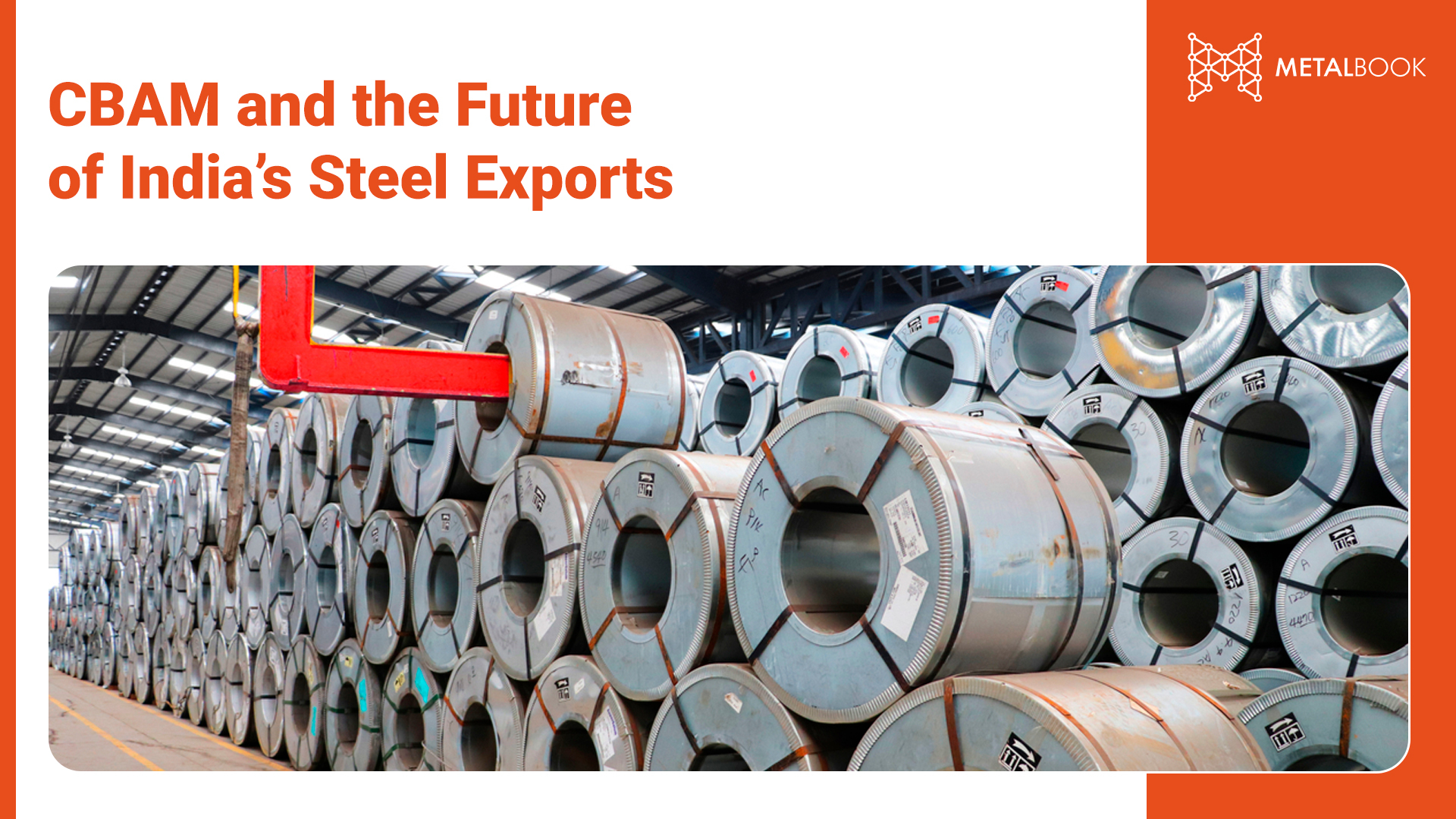
CBAM and the Future of India’s Steel Exports
Key Takeaways
- Carbon pricing is now embedded in the global steel trade and directly impacts export competitiveness.
- Indian steel faces higher exposure due to coal-based production and higher emission intensity.
- Export strategies are shifting toward the Middle East, Africa, and Southeast Asia to protect margins.
- Early investment in emissions tracking and decarbonization can preserve EU market access
Understanding the Real Cost of Carbon — and the Road Ahead for Indian Producers
The global steel industry is currently going through a pivotal transformation regarding carbon emissions; once considered an external environmental problem, carbon emissions are now viewed as a cost when trading globally. At the forefront of this transformation is the European Union's (EU) Carbon Border Adjustment Mechanism (CBAM), which is changing the way steel is processed, manufactured, traded, and priced in Europe. For India, one of the largest producers of steel in the world and historically a large supplier to Europe, the CBAM represents both an opportunity and a challenge; while it does not prohibit Indian steel from entering the EU, it does impose a carbon price that rewards low-carbon emitters and efficiency while penalizing high-carbon emitters. Therefore, knowing how the CBAM operates and how it relates to the steel ecosystem in India is critical for producers, traders, original equipment manufacturers (OEMs), as well as consumers/buyers.
What CBAM Is and Why It Changes Global Steel Trade
The European Union has developed the CBAM system, which is intended to play a level playing field between local and imported goods by providing them equal access to the EU carbon market. European steel producers already operate under the EU Emissions Trading System, where they must purchase allowances for every tonne of carbon dioxide they emit. CBAM extends this principle to imports by placing a carbon price on steel based on the emissions generated during its production.
In addition to focusing on the ‘reporting’ phase of the CBAM opportunity, the transitional phase of CBAM began in January 2023, with the emphasis on gathering information about the carbon content of imported steel. Beginning on January 1, 2026, CBAM will be fully enforced, and importers will be required to pay for the carbon contained in their shipped steel. The implication is straightforward: steel with higher emissions will arrive in Europe with a higher landed cost. Carbon intensity, therefore, becomes as important as price, quality, and delivery timelines.
Why India’s Steel Sector Faces Higher Exposure
India’s exposure to CBAM stems primarily from the structure of its steelmaking industry. Most Indian steel is produced via a blast furnace -basic oxygen furnace route, which produces more carbon emissions compared to how steel is generally produced in Europe and the US with electric arc furnaces. The emission intensity of steel produced in India is approximately 2.5 tons of CO₂ per ton of crude steel, while globally this is approximately 1.9 tons, and in scrap-based systems can be as low as 1.3 to 1.5 tons of CO₂ per ton of crude steel.
There are various structural reasons for this large differential between India and the world. An overwhelming majority of mills in India utilize coal-based sources of energy; they also use significantly less scrap to produce steel and still have older technologies operating within some clusters. In India there is very limited implementation of renewable energy, and carbon capture remains very limited; however, both are becoming more prevalent. Because there are structural differences under CBAM when comparing India to the rest of the world, the differences will not be as an export penalty; instead, it will have price implications due to the embedded emissions.
Translating Emissions into Actual Cost
To understand CBAM’s commercial impact, it is useful to translate emissions into monetary terms. Using a conservative EU carbon price of about €80/tonne CO₂, steel produced in India with an average emission intensity will incur an additional cost of about €200/tonne when exported to the EU. If the steel was produced using more advanced blast furnace technologies, the additional cost would likely be a little less than €180/tonne; if using older technologies, then the additional costs could be greater than €220/tonne.
In Indian currency, this translates into additional costs of between ₹13,000 and ₹19,000/tonne for Indian companies. Due to the low profit margins associated with commodity products (i.e. hot rolled coil, cold rolled sheet, wire rod), this additional cost may result in zero profit or, in some instances, a loss. Estimates prepared by KPMG suggest that CBAM could increase the effective costs of EU exports by between 20% and 35%, depending upon product and production methodology.
How Export Markets Are Already Responding
While CBAM is still being implemented, some aspects of how businesses operate are changing now. For example, buyers in Europe are becoming more interested in the emissions produced during production at the facility level and have started requesting this information from suppliers. Third-party verification of the emissions data and supporting documentation for the sources of energy used to produce the products is being requested. Many suppliers do not have access to reliable data and are finding it difficult to obtain contracts from large OEMs and service providers.
At the same time, Indian exporters are diversifying their exposure to different markets. There has been a significant increase in the volumes of products that were previously going to Europe and are now being shipped to other regions, such as the Middle East and Africa, where there is increased demand for products being manufactured with the infrastructure available. These regions do not yet have established carbon pricing mechanisms in place, allowing them to have a better return on investment for product sales.
Is Europe Still a Viable Market for Indian Steel?
Europe remains an important market, but it is no longer universally viable for all Indian steel products. The market increasingly favours low-carbon steel , value-added grades, and long-term OEM-linked supply contracts. Producers using electric arc furnaces, higher scrap content, renewable energy, or hybrid production routes are better positioned to absorb or minimize CBAM costs. On the other hand, steel producers producing high-carbon steel are at increased risk due to the likelihood of a weaker demand.
Strategic Opportunities Beyond the EU
With the tightening of EU margins via CBAM bringing about greater restrictions, alternative markets are becoming more commercially viable on a global scale. The Middle Eastern market has been investing intensively in major infrastructure, energy & industrial development, driving demand for rebar, structural steel and semi-finished products (SFP) in Middle Eastern countries.
The African region, on the other hand, is one of the fastest-growing regions for steel demand globally, driven by investments in transportation, power generation and renewable energy.
They are generally lower price realization than European markets, typically longer payment cycles and higher credit risks. However, when factoring in the costs associated with CBAM, exporters will frequently find that their net returns are considerably more stable outside of Europe. For Indian producers, this diversification reduces dependence on a single high-regulation market and improves overall resilience.
How CBAM Can Create Long-Term Advantages for India
The introduction of CBAM will bring short-term cost pressures on Indian steel production, but it also presents a long-term opportunity for Indian steelmakers who take action early. Steelmakers who invest in emissions reduction, renewable energy and transparent reporting will have the opportunity to access premium segments in Europe, secure long-term contracts with global OEM's and enhance their attractiveness to ESG-focused financiers.
India has a significant scale and engineering capability in the steel sector, and there is an opportunity for the Indian steel industry to leverage both of these attributes, along with gradually decarbonizing its operations through modern technology and digital compliance, to provide sustainable competitive advantages. CBAM is accelerating the pace of this transition within the global steel production market, which was already being facilitated by the market before the introduction of the CBAM.
2026 Outlook: The Full Enforcement Phase
The year 2026 is the critical inflection point for CBAM. From January, EU importers must pay for embedded carbon in steel shipments, moving the mechanism from a reporting exercise to a fully enforceable financial cost. Early estimates are that CBAM could potentially increase prices for Indian steel exports by up to €200–€225 per metric tonne, thus negatively impacting margins for producers of high-emission-intensity commodity versions of Indian steel. Producers who begin using lower carbon steel production processes, increase their use of recycled scrap, and adopt fully transparent CO2 emission reporting systems will be best positioned to maintain access to the European Union steel market. Producers that do not take these steps may decide to pursue growth opportunities in alternate regions, including the Middle East, Africa and Southeast Asia.
What Indian Producers and Supply-Chain Players Should Focus on Now
The most immediate priority for Indian steelmakers is measurement. Accurate tracking of emissions at the batch and plant level is essential, not only for CBAM compliance but also for internal efficiency improvements. Establishing robust Documentation/Verification Systems with third parties will soon be required as a condition of doing Business in Premium Export Markets. At the Strategic level, Exporters will need to be more Strategic in their product mix and market Segmentation. Low-Carbon and High-Grade Steel will be targeted to Europe, while volumes of Commodities will be optimized for areas that do not yet have applicable Carbon Costs. At the same time, through the Utilization of Scrap and Investment in Renewable Power Procurement and Process improvements, it will be possible to reduce Emissions over time, without the need for disruptive Capital Investments being made at one time.
What This Means for Buyers, OEMs, and Traders
The CBAM impact extends throughout the steel value chain. Buyers and OEMs must factor in carbon intensity when making purchasing decisions; traders and digital platforms can capitalize on this opportunity to enhance traceability/verification/compliance. As a result, transparency will provide a competitive advantage instead of a regulatory burden in the current market.
Conclusion
CBAM marks the beginning of a carbon-priced global steel economy. For Indian producers, it introduces near-term pressure but also clarifies the path forward. Those who invest in emissions measurement, market diversification, and gradual decarbonization will remain globally competitive. Those who delay risk being priced out—not because of quality or capacity, but because carbon has become part of the cost structure.
For India’s steel ecosystem, the message is clear: carbon is no longer an external factor. It is now a core determinant of trade, pricing, and long-term competitiveness.